
PCP Prophylaxis Risk Calculator
This tool helps you determine if you're at risk for Pneumocystis pneumonia (PCP) based on your current medications and immune status. PCP prophylaxis may be needed for certain immunosuppressed patients to prevent this life-threatening infection.
When Do You Need Antibiotics to Prevent a Rare but Deadly Lung Infection?
If you’re on long-term steroids or other immunosuppressants, you might have been told to take an antibiotic every day-not to treat an infection, but to prevent one. That’s pneumocystis pneumonia (PCP) prophylaxis. It sounds alarming. You’re not sick, yet you’re on a daily drug that can cause rashes, nausea, or low blood counts. Why? Because PCP kills. And while it’s rare, if you’re at risk and don’t get preventive treatment, your chances of dying from it jump to 30-50%.
PCP isn’t caught from a coworker or a dirty doorknob. It’s caused by a fungus called Pneumocystis jirovecii that most people carry harmlessly in their lungs. Your immune system keeps it in check. But when your immune system is turned down-by drugs like prednisone, cyclophosphamide, or mycophenolate-that fungus can explode into a full-blown infection. And once it does, it’s hard to treat.
Who’s Actually at Risk?
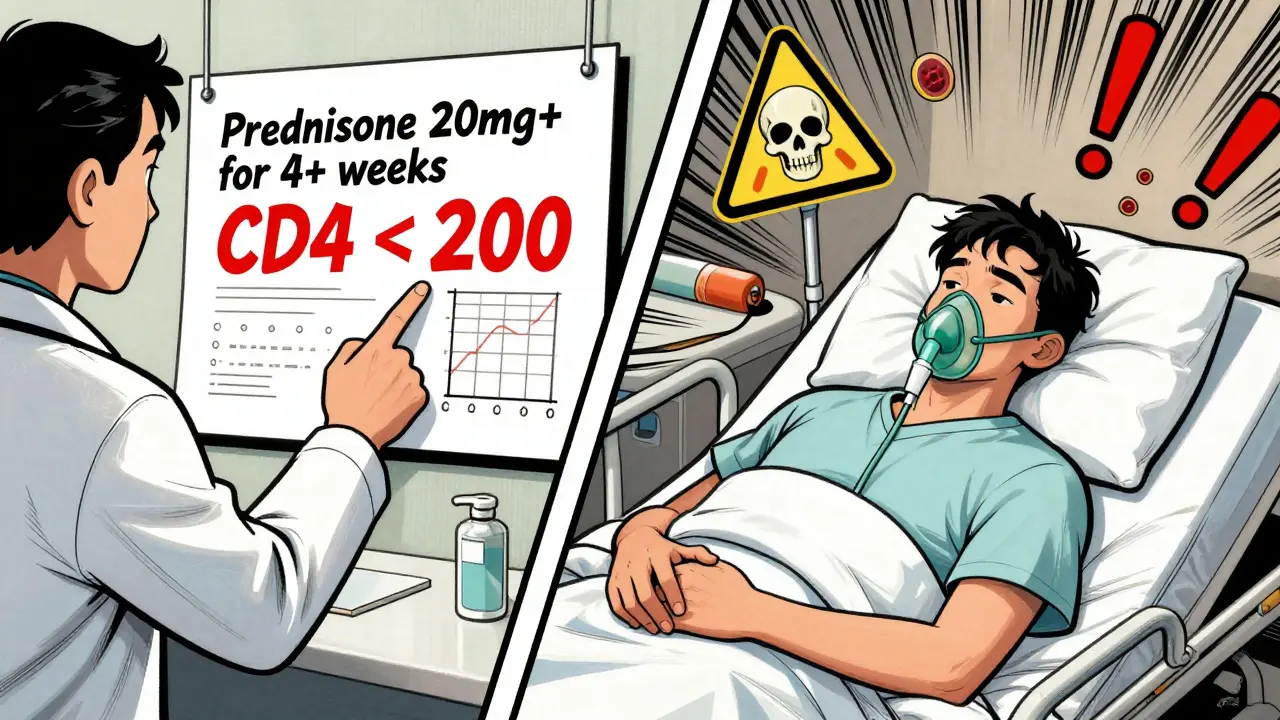
Not everyone on immunosuppressants needs PCP prophylaxis. But some groups are clearly in danger. The biggest red flag? High-dose steroids. If you’re taking prednisone at 20 mg or more per day for 4 weeks or longer, guidelines from the British Columbia Renal Agency and the CDC say you should be on prophylaxis. That’s not a guess. It’s based on decades of data showing PCP cases spike at this dose and duration.
But it’s not just steroids. If you’re on cyclophosphamide-common for vasculitis, lupus, or kidney disease-you’re at high risk. Experts recommend prophylaxis during treatment and for at least 3 months after you stop. Why? Because the drug wipes out immune cells for a long time. Even if you feel fine, your body is still vulnerable.
What about other drugs? Azathioprine or mycophenolate alone? Usually not enough to trigger prophylaxis. But if you’re on one of those plus steroids? That’s a different story. The combination is like turning off two safety switches at once. The Ontario Renal Network says to treat the combination as high risk.
And don’t forget your blood counts. If your lymphocyte count is below 0.5 x 10⁹/L, or your CD4 count is under 200 cells/µL-even if you don’t have HIV-you’re in the danger zone. Some rheumatologists now check CD4 levels routinely in patients on strong immunosuppressants. If it’s low, prophylaxis kicks in.
What’s the First-Line Drug? And What If You’re Allergic?
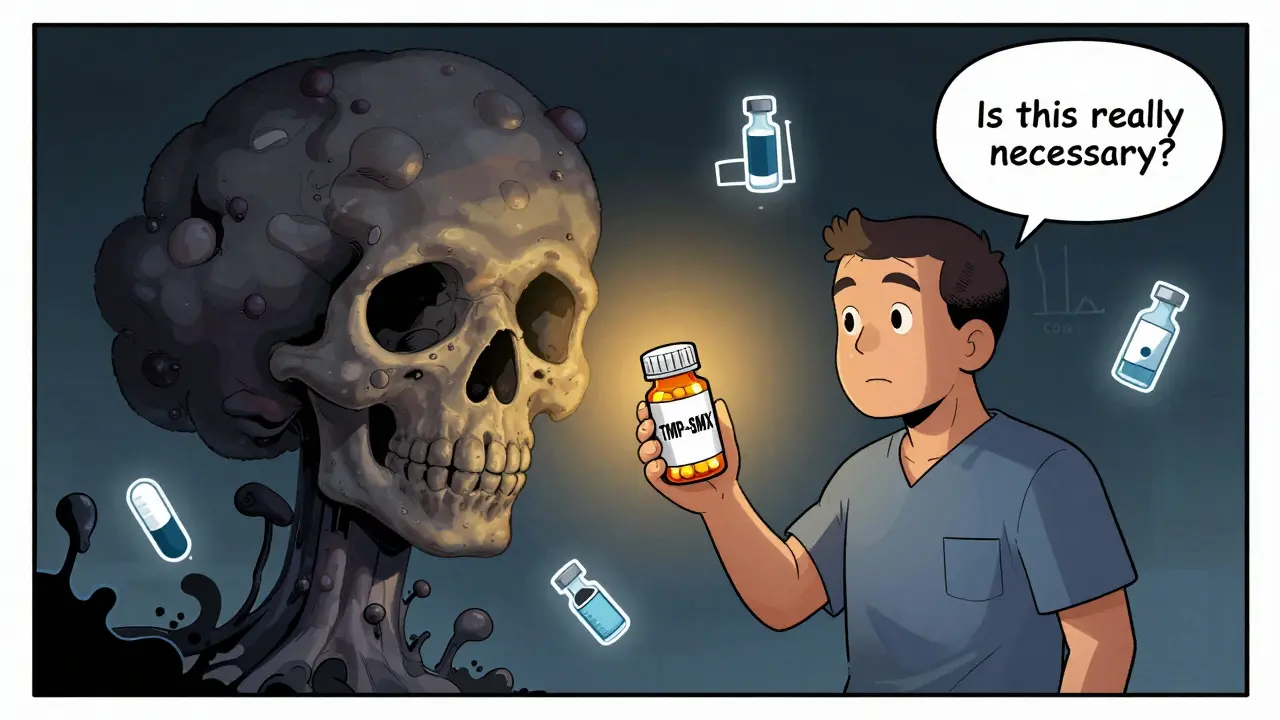
The gold standard is trimethoprim-sulfamethoxazole (TMP-SMX), sold as Bactrim or Septra. One double-strength tablet daily. Cheap. Effective. Proven over decades. It reduces PCP risk by more than 90%.
But here’s the catch: 20-30% of people can’t tolerate it. You might get a rash, nausea, or low white blood cells. That’s why alternatives exist.
- Dapsone (100 mg daily) - good option, but avoid if you’re on mycophenolate. Both can suppress your bone marrow.
- Dapsone + pyrimethamine + leucovorin (weekly) - used for sulfa allergies, but needs monitoring for blood issues.
- Atovaquone (1500 mg daily) - easier on the stomach, but expensive and less studied in non-HIV patients.
- Aerosolized pentamidine (inhaled monthly) - avoids the gut, but messy. Requires a special nebulizer. Not for pregnant women.
And yes, leucovorin is no longer routinely added to TMP-SMX. That was an old habit. New data shows it doesn’t help prevent side effects. Skip it unless your doctor has a specific reason.
Why Are So Many Doctors Not Prescribing It?
Here’s the uncomfortable truth: even though guidelines exist, many doctors don’t follow them. A 2018 study tracked 316 patients with autoimmune diseases on high-risk drugs. Only 39% got prophylaxis. And that included people on cyclophosphamide-the drug with the clearest risk.
Why? Several reasons. First, PCP is rare. In some clinics, they might go years without seeing a case. So it feels like overkill. Second, doctors fear side effects. If you’re already feeling awful from your disease or other meds, adding another drug feels like piling on.
But here’s what the data doesn’t say: the risk of PCP is far worse than the risk of side effects. TMP-SMX causes an adverse event in about 2.2% of patients per year. PCP kills up to half of those who get it without treatment. That’s a huge trade-off.
And guess what? In that same study, not a single patient got PCP-even those who skipped prophylaxis. Sounds reassuring, right? But the follow-up was only 2 years. PCP can strike after 18 months. And the cost of one hospitalization? $25,000 to $65,000. Prophylaxis? Less than $200 a year.
What About Low-Dose Steroids? Do You Need It?
This is where things get murky. For years, the cutoff was 20 mg of prednisone per day. But new research from 2025 shows cases of PCP happening in patients on as little as 10-15 mg/day-especially if they’re also on another immunosuppressant, have a low CD4 count, or have had recent infections like CMV.
So if you’re on 15 mg of prednisone and also on azathioprine? Your doctor should think twice before skipping prophylaxis. It’s not just the dose. It’s the combination. It’s your blood counts. It’s your history.
Some experts now say: don’t just look at the pill count. Look at the person. If you’ve had pneumonia before, or your lymphocytes are low, or you’re over 65? Even lower steroid doses might warrant protection.
What Happens If You Stop Prophylaxis?
You don’t take it forever. Once your immune system recovers, you can stop. For steroid users, that usually means when you’re down to under 20 mg/day for at least a month. For cyclophosphamide, wait 3 months after your last dose.
But don’t stop on your own. Talk to your doctor. Check your CD4 count. If it’s still below 200, keep going. If you’re on a taper, don’t assume you’re safe just because the dose went down. Immune recovery takes time.
And if you’re pregnant? You can still take TMP-SMX or dapsone. But avoid atovaquone and pentamidine in the first trimester. There’s not enough safety data.
Why Isn’t There a Clear Guideline for Autoimmune Patients?
Here’s the biggest gap in medicine right now: there’s no universal guideline for non-HIV patients. The CDC and IDSA have solid rules for HIV. But for lupus, rheumatoid arthritis, or vasculitis? It’s a patchwork.
Why? Because autoimmune diseases aren’t one thing. A person with lupus nephritis on high-dose steroids and cyclophosphamide is very different from someone with mild RA on low-dose methotrexate. One group needs prophylaxis. The other doesn’t. But the labels are the same: “immunosuppressed.”
That’s why doctors are confused. And that’s why patients get mixed messages. Some are told to take it. Others aren’t even warned. The 2023 JAMA commentary called this a “clinical gray zone.” The solution? Personalized risk assessment. Not blanket rules.
What Should You Do?
If you’re on immunosuppressants, ask your doctor these questions:
- Am I on a drug or combo that puts me at risk for PCP?
- What’s my current CD4 count and lymphocyte level?
- How long have I been on this dose? Is it likely to stay this high?
- What’s the plan if I can’t take TMP-SMX?
- When will we re-evaluate if I can stop?
Don’t assume you’re safe because you feel fine. Don’t skip prophylaxis because you’re scared of side effects. And don’t wait for your doctor to bring it up. Bring it up yourself.
PCP is preventable. But only if you know you’re at risk-and you act.
What About Antibiotic Resistance?
Many patients worry: if I take antibiotics every day, won’t I create superbugs?
Good question. But here’s the answer: TMP-SMX prophylaxis for PCP does not increase resistance to the fungus. Pneumocystis jirovecii hasn’t developed resistance to it in decades. The resistance you hear about-like MRSA or resistant E. coli-is from bacteria, not fungi. This is a different class of bug entirely.
And studies show no spike in bacterial resistance in patients on long-term PCP prophylaxis. The fear is real, but the data doesn’t back it up.
Bottom Line: Don’t Guess. Ask.
PCP prophylaxis isn’t optional for high-risk patients. It’s life-saving. But it’s not for everyone. The key is knowing your risk-not just your diagnosis, but your dose, your blood counts, your other meds, and your history.
If you’re on 20 mg or more of prednisone for over a month, or on cyclophosphamide, you’re likely in the high-risk group. Start prophylaxis. If you’re on lower doses or single agents, talk to your doctor about your individual risk. Don’t let confusion or silence put you in danger.
One antibiotic a day might feel like overkill. But compared to the alternative? It’s the smartest choice you’ll make this year.
Do I need PCP prophylaxis if I’m on low-dose steroids?
Not always. If you’re on less than 20 mg of prednisone per day and not on other immunosuppressants, your risk is low. But if you’re also taking azathioprine or mycophenolate, or if your CD4 count is below 200, you may still need it. Talk to your doctor about your specific combination and blood work.
Can I stop PCP prophylaxis if I feel better?
No. Feeling better doesn’t mean your immune system has recovered. Prophylaxis is based on drug dose and duration, not symptoms. You can only stop when your doctor confirms your steroid dose is below 20 mg/day for at least a month, or 3 months after stopping cyclophosphamide-and your CD4 count is above 200.
What are the most common side effects of TMP-SMX?
The most common side effects are rash (15%), nausea or stomach upset (28%), and low white blood cell count (5%). These usually appear in the first 4-8 weeks. If you get a severe rash or fever, stop the drug and call your doctor immediately. Don’t restart it without testing for allergy.
Is PCP prophylaxis covered by insurance?
Yes. TMP-SMX is generic and costs less than $20 a month. Most insurance plans cover it fully. Dapsone and atovaquone are more expensive but still usually covered with prior authorization. If you’re denied, ask your doctor to write a letter explaining your high-risk status based on CDC or BC Renal guidelines.
Why do some doctors refuse to prescribe it?
Some doctors think PCP is too rare to justify daily antibiotics. Others fear side effects or don’t know the latest guidelines. A 2022 study found doctors with under 5 years of experience were 3 times more likely to skip prophylaxis. It’s not always about patient risk-it’s about clinician awareness.
Can I take PCP prophylaxis if I’m pregnant?
Yes. TMP-SMX and dapsone are considered safe during pregnancy. Avoid atovaquone and aerosolized pentamidine in the first trimester due to unclear fetal safety. Always inform your OB and rheumatologist or nephrologist if you’re pregnant and on immunosuppressants.
All Comments
Ambrose Curtis January 28, 2026
I was on 30mg prednisone for 6 months after my kidney transplant and they never mentioned PCP prophylaxis until I got sick. Then it was like, oh yeah, you should’ve been on Bactrim this whole time. 20mg+ for 4+ weeks? That’s not a suggestion, it’s a rule. Why do docs wait until you’re in the ICU to bring it up?
James Dwyer January 29, 2026
This is one of those posts that should be printed and taped to every rheumatologist’s wall. So many people suffer needlessly because no one talks about this until it’s too late.
jonathan soba January 31, 2026
The fact that only 39% of high-risk patients get prophylaxis isn’t negligence-it’s systemic failure. The medical system prioritizes cost avoidance over outcome prevention. And now we’re surprised when people die from something that costs less than a coffee a day to prevent?
Jess Bevis January 31, 2026
TMP-SMX is cheap. PCP isn't. End of story.
Rose Palmer February 1, 2026
As a clinical pharmacist, I cannot stress enough: if you are on cyclophosphamide or prednisone ≥20 mg/day for ≥4 weeks, prophylaxis is not optional. It is standard of care. Documenting your risk assessment and patient education is not just good practice-it is legally defensible. Please, patients: ask for your CD4 and lymphocyte counts. If your provider doesn’t know, they’re not keeping up.
Howard Esakov February 3, 2026
Honestly, if you’re on immunosuppressants and you didn’t already know about PCP prophylaxis, you probably shouldn’t be trusted to manage your own meds. This isn’t rocket science. It’s basic immunology. The fact that this even needs to be explained in 2025 is embarrassing.
Mindee Coulter February 3, 2026
I’m on azathioprine + 15mg prednisone and my rheum just said I don’t need it because I ‘feel fine’. I looked up my CD4 last week-187. I’m starting Bactrim tomorrow. If you’re on combo therapy and your lymphs are low, don’t wait for permission. Save yourself.
Rhiannon Bosse February 4, 2026
So let me get this straight… we’re giving people daily antibiotics to prevent a fungus they already have in their lungs… but we won’t test for it until they’re gasping for air? And the drug that prevents it causes rashes so we avoid it? Meanwhile, Big Pharma sells us $12,000/month biologics and calls it innovation? This isn’t medicine. This is a scam dressed in white coats.
Linda O'neil February 4, 2026
I had PCP in 2018 after a lupus flare. I was on 25mg prednisone and azathioprine. No one warned me. I spent 17 days in the ICU. My CD4 was 112. I’m on prophylaxis for life now. If you’re on combo immunosuppressants, don’t wait for symptoms. Ask for the test. Ask for the pill. You’re not being paranoid-you’re being smart.
Irebami Soyinka February 6, 2026
America still treating fungal infections like they’re optional? In Nigeria, if you’re on steroids, you get prophylaxis by default. No questions. No debate. We don’t wait for people to die before we act. Maybe your system is broken, not your immune system.
doug b February 8, 2026
My doc said I didn’t need it because I’m young and healthy. I’m 32. I’ve had two pneumonia episodes in 3 years. I’m starting Bactrim. If you’re on anything that kills your immune cells, you don’t get to gamble with your lungs.
Mel MJPS February 8, 2026
Thank you for writing this. My sister was diagnosed with PCP last year. She’s fine now, but she didn’t know she was at risk. I’m sharing this with everyone I know on immunosuppressants. You’re not just giving info-you’re saving lives.