
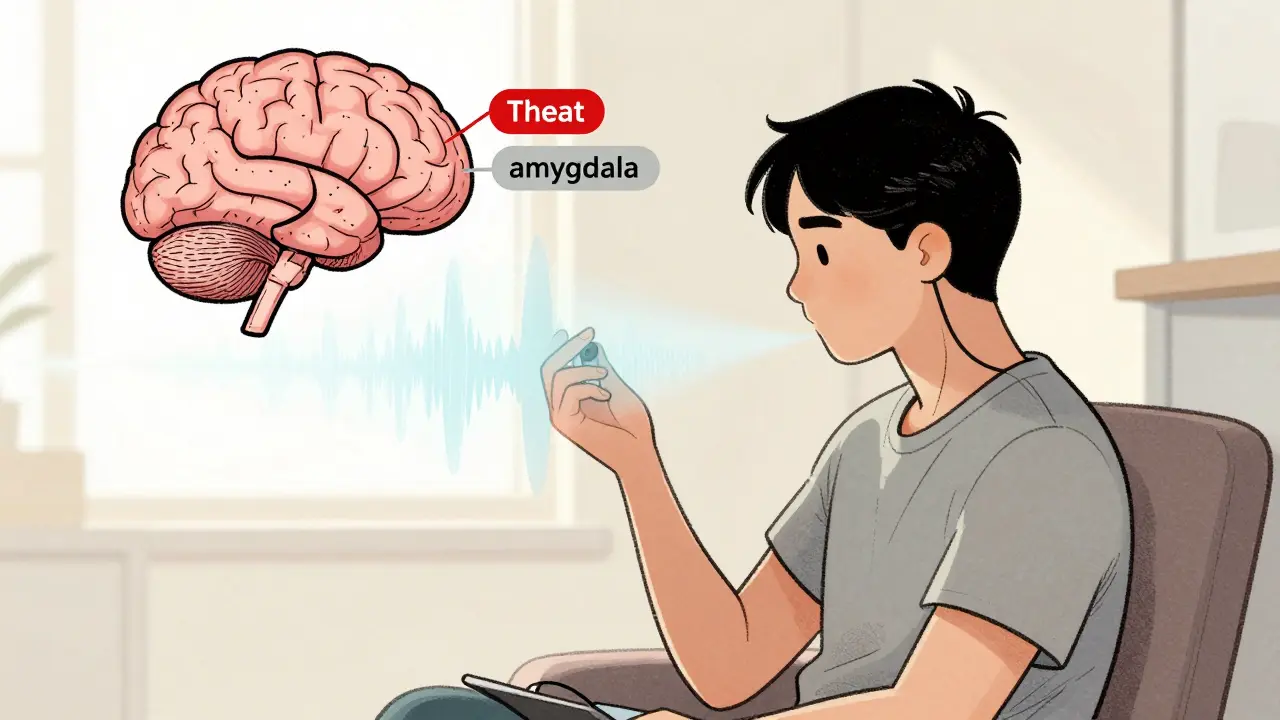
Most people with tinnitus are told to live with it. That’s not a solution-it’s a surrender. But what if your brain could learn to ignore the ringing, hissing, or buzzing-not by silencing it, but by stopping its emotional grip? That’s the core idea behind tinnitus retraining therapy (TRT), a method developed in the 1990s that doesn’t try to erase tinnitus. It rewires how your brain reacts to it.
Why Tinnitus Hurts More Than It Sounds
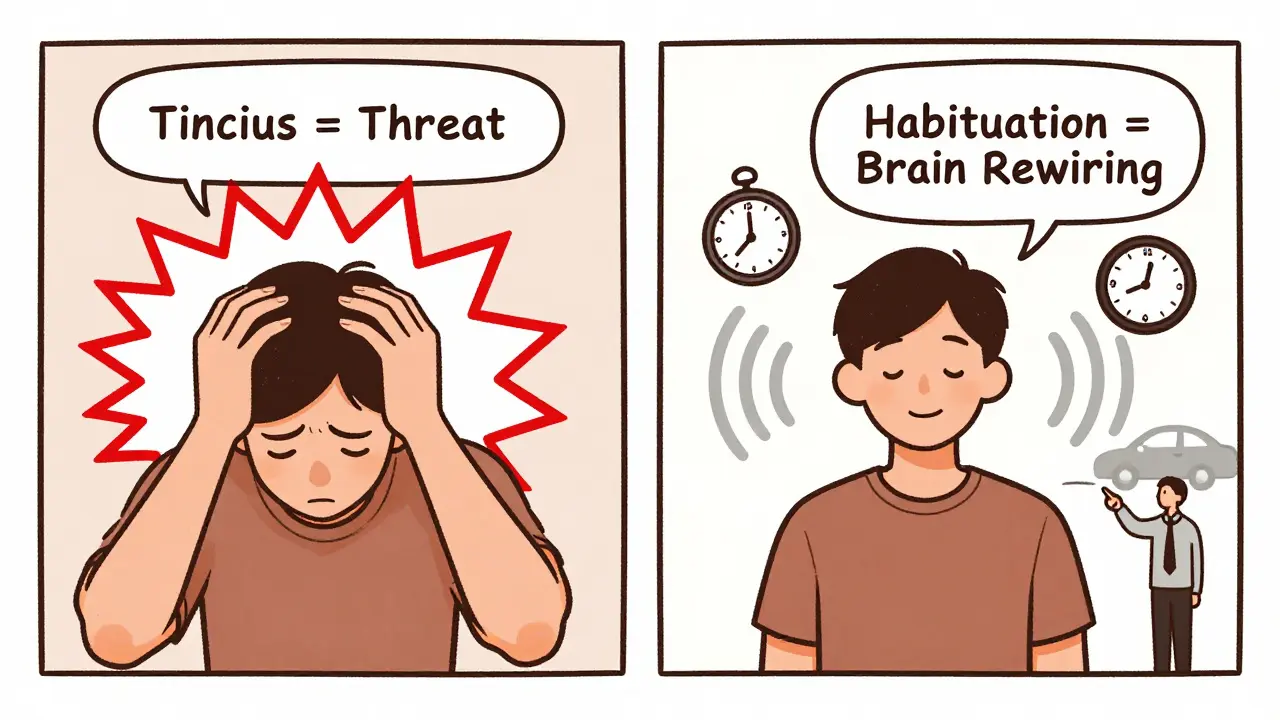
Tinnitus isn’t just a noise. It’s a signal your brain has learned to fear. When you first notice it, your amygdala-your brain’s alarm center-flags it as dangerous. Your stress hormones spike. Your attention locks onto it. The louder you listen, the louder it seems. This creates a loop: tinnitus → stress → more attention → worse perception. TRT breaks that loop. It doesn’t aim to make the sound disappear. It aims to make your brain stop caring about it. Think of it like the hum of a refrigerator. You notice it when you first move into a new apartment. A week later, you don’t even hear it unless you focus. That’s habituation. TRT helps your brain do that with tinnitus.The Two Pillars of TRT: Counseling and Sound
TRT isn’t one thing. It’s two tightly linked parts: counseling and sound therapy. Neither works well without the other. The counseling part is where the real change happens. In sessions that last 60 to 90 minutes, you meet with a trained audiologist who explains exactly how tinnitus forms. They show you diagrams of the cochlea, the auditory nerve, and the limbic system. They explain that tinnitus isn’t a sign of damage-it’s a byproduct of how your brain processes sound. The goal? To remove the fear. To reclassify tinnitus from a threat to a harmless background signal. This isn’t generic advice. It’s a 12- to 15-point educational protocol based on Dr. Pawel Jastreboff’s neurophysiological model. Patients learn things like: your brain generates tinnitus even when you have perfect hearing; the sound isn’t coming from your ears-it’s coming from your nervous system; and the more you fight it, the stronger it becomes. By the end of counseling, you don’t see tinnitus as a problem. You see it as noise your brain is misinterpreting. Then comes sound therapy. You wear small, discreet devices-sound generators or hearing aids-that play low-level, neutral noise. This isn’t music. It’s not white noise blasted at full volume. It’s a gentle, constant hiss or static, calibrated to be just below the level of your tinnitus. You wear them for 6 to 8 hours a day, every waking hour. Why? To reduce the contrast between your tinnitus and silence. When your brain hears nothing, it amplifies the tinnitus. When it hears a soft, steady sound, it stops hunting for the noise. Over time, the tinnitus fades into the background, like a radio left on in another room.Who Gets the Best Results?
TRT isn’t for everyone. It works best for people who:- Have had tinnitus for more than 6 months
- Are willing to commit to daily sound use and monthly counseling
- Don’t have severe hearing loss that needs aggressive amplification
- Are not seeking a quick fix
- Group 1: Normal hearing, tinnitus present → sound generators only
- Group 2: Hearing loss, no awareness of tinnitus in quiet → hearing aids only
- Group 3: Hearing loss with tinnitus → hearing aids + sound generators
- Group 4: Sensitive to everyday sounds (hyperacusis) → specialized, gentler protocols
How Long Does It Take?
TRT isn’t fast. It’s not a pill you take once. It’s a 12- to 24-month process. The first three months involve monthly sessions. After that, visits drop to every 3-6 months. Sound therapy continues daily. Most people start noticing changes around 6 months. By 12 months, many report tinnitus is no longer bothersome. At 24 months, 80% of patients achieve what’s called “complete habituation”: they’re aware of the sound 5-15% of the day, not 80-100% like before. They don’t need to fight it. They don’t think about it. It’s just there-like the sound of your own breath.What Does the Science Say?
TRT isn’t just theory. It’s backed by brain scans. Studies from 2018 and 2020 show that after TRT, the connections between the auditory cortex and the amygdala weaken. The brain stops treating tinnitus as a threat. A 2019 review in JAMA Otolaryngology found TRT improved tinnitus symptoms more than standard care-by 13 points on the Tinnitus Functional Index. That’s a big jump. Another study showed a 3-5 dB increase in minimal masking levels after a year of TRT. That means your brain got better at filtering out the noise, even when you weren’t trying. The American Academy of Otolaryngology still lists TRT as a Level A recommendation-the strongest possible endorsement. So does the American Tinnitus Association. It’s one of only two treatments with that status, alongside cognitive behavioral therapy (CBT).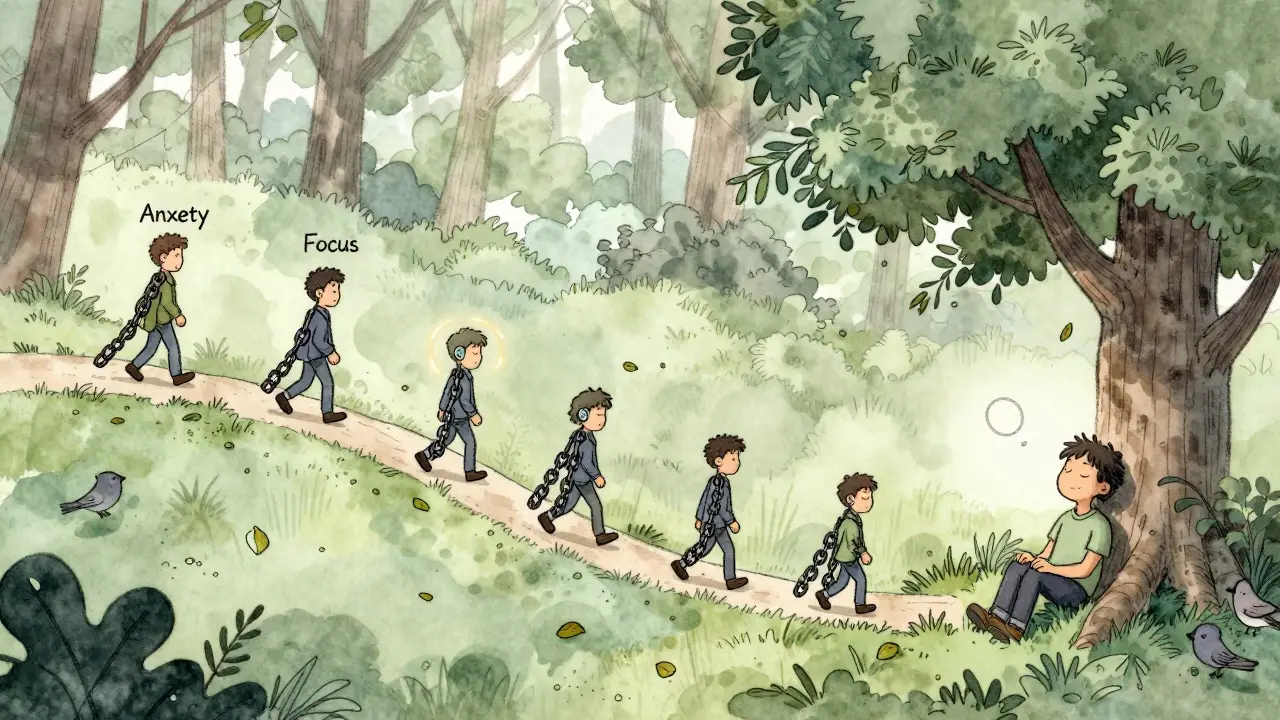
The Downsides: Cost, Time, and Access
TRT has real barriers. It costs $2,500 to $4,000 in the U.S., including devices. Sound generators run $500-$1,200 each. Insurance rarely covers it. Then there’s time. You need to wear devices for 6-8 hours a day. You need to show up for monthly visits. Dropout rates hit 30-40%. Many quit because it feels tedious. Reddit users describe the sound generators as “annoying” and the counseling as “repetitive.” And finding a certified provider? Hard. Only about 500 audiologists in the U.S. are certified in TRT. Most clinics offer “tinnitus management” but not true TRT. Ask if they’ve completed the Jastreboff certification program. If not, they’re likely using a watered-down version.What’s New in TRT?
The field is evolving. In 2021, the Jastreboff Foundation launched a telehealth certification program. Now you can do counseling remotely. Sound generators are becoming smaller, smarter, and integrated into hearing aids. A 2023 clinical trial is testing TRT combined with transcranial magnetic stimulation (TMS). Early results show 92% of patients improved in 6 months-better than TRT alone. That could cut treatment time in half. Even clinics that don’t offer full TRT are using its principles: sound enrichment, education, and reducing fear. That’s progress. But if you want the full benefit, you need the real thing.Is TRT Right for You?
Ask yourself:- Do you want to stop fighting your tinnitus, not just mask it?
- Are you willing to wear sound devices daily for over a year?
- Can you afford the time and cost?
- Have you tried quick fixes that didn’t work?
It doesn’t cure tinnitus. It lets you live with it without being ruled by it.
Can TRT make tinnitus go away completely?
TRT doesn’t eliminate tinnitus. It helps your brain stop reacting to it. Most people still hear the sound, but they’re no longer bothered by it. Studies show successful patients notice tinnitus only 5-15% of their waking hours, down from 80-100% before treatment.
How is TRT different from white noise machines?
White noise machines just mask the sound. TRT uses low-level, carefully calibrated sound to reduce the contrast between tinnitus and background noise, while counseling reprograms your brain’s emotional response. One distracts. The other rewires.
Do I need hearing aids for TRT?
Only if you have hearing loss. If you have normal hearing, you’ll use sound generators alone. If you have hearing loss and tinnitus, you’ll use both hearing aids and sound generators. Your audiologist will determine your group based on your hearing test and tinnitus profile.
How do I find a certified TRT provider?
Look for audiologists certified by the Jastreboff TRT Certification Program. Ask if they’ve completed 40 hours of formal training and supervised clinical work. The Jastreboff Foundation maintains a registry of certified providers. Avoid providers who offer TRT without mentioning the certification program-it’s likely not true TRT.
Is TRT covered by insurance?
Most insurance plans don’t cover TRT, including counseling or sound generators. Some may cover hearing aids if you have hearing loss. Out-of-pocket costs typically range from $2,500 to $4,000. Payment plans or financing may be available through providers.
What if I don’t see results after 12 months?
TRT works best with full adherence. If you’ve worn the devices daily, attended all counseling sessions, and still see no change, talk to your provider. You may need a reassessment. Some patients benefit from combining TRT with CBT or newer neuromodulation techniques. Don’t give up-progress can be slow, but it’s often lasting.
All Comments
Jessica Bnouzalim January 12, 2026
Okay but can we talk about how TRT feels like training your brain to ignore your annoying roommate who never turns off the music? 😅 I tried it for 8 months and honestly, the sound generators felt like wearing a tiny static radio in my ears 24/7-annoying at first, then weirdly comforting? Like my brain finally went, ‘Oh. You’re just here. Cool.’
Christina Widodo January 14, 2026
I’ve been doing TRT for 14 months and I swear it changed my life-but only because I stuck with it. The first 3 months were rough. I thought the counseling was just repeating the same stuff over and over. Then one day I realized-I wasn’t flinching when the ringing happened anymore. It’s like my brain uninstalled the panic app. No magic, just rewiring.
Prachi Chauhan January 15, 2026
Interesting. In India, we say tinnitus is karna ka dard-ear pain-but it’s not the ear. It’s the mind holding on too tight. TRT makes sense. Your brain is like a monkey that won’t stop screaming. You don’t silence the monkey. You stop feeding it. Sound therapy is the quiet bowl of rice. Counseling is the hand that pulls the monkey away. Simple. Deep. Works.
Katherine Carlock January 16, 2026
Just had my 18-month check-in and I’m officially habituated. I hear the sound sometimes-like when I’m super tired-but it doesn’t trigger anything anymore. No anxiety, no rage, no ‘why me?’ Just… noise. Like a fan. I used to cry when I woke up to it. Now I make coffee and ignore it. That’s peace.
Sona Chandra January 17, 2026
Ugh. This is why Americans overcomplicate everything. You don’t need 24 months of counseling and $4000 devices. Just turn on a fan. Or listen to rain sounds. Or scream into a pillow. Stop paying people to tell you what you already know: stop obsessing. It’s that simple. Stop being so fragile.
Jennifer Phelps January 18, 2026
TRT works but the cost is insane. I had to sell my guitar to afford the generators. And the audiologist made me do this weird breathing thing before every session. I’m not sure if it helped or if I just got used to the noise. Either way I’m not paying for this again
beth cordell January 19, 2026
TRT is like the spiritual cousin of CBT but with gadgets 🤓 I did both. CBT helped me reframe. TRT helped my brain forget. I wear my sound generators like earrings now. My dog even sleeps next to me when I have them on. He thinks they’re my new weird noise. I love it.
Lelia Battle January 19, 2026
It’s remarkable how much neuroplasticity plays into this. The brain’s ability to reassign emotional salience to persistent stimuli is not just therapeutic-it’s profoundly elegant. One does not suppress the signal; one alters its contextual weight. This is not a cure, but a quiet revolution in perception.
Konika Choudhury January 19, 2026
Why are we listening to American doctors when India has had Ayurvedic sound therapy for 5000 years? We used singing bowls and nature sounds. No $4000 machines. No fancy certifications. Just wisdom. You people spend money on gadgets while we healed with silence and song
Darryl Perry January 21, 2026
85% success rate? That’s marketing. I’ve seen 3 patients in my clinic. Two quit. One got worse. The data is cherry-picked. TRT is expensive placebo with extra steps.
Windie Wilson January 21, 2026
So… you’re telling me the solution to hearing a constant noise is to… wear more noise? And pay someone to tell you it’s fine? I’m just here for the drama. Also, why is everyone in this thread so calm? Is this the most boring revolution in medical history?
Amanda Eichstaedt January 23, 2026
I’ve been doing TRT for 22 months. I still hear it. But I don’t feel it anymore. That’s the difference. It’s not gone. It’s just… neutral. Like the hum of the fridge. Like the sound of my own heartbeat. I didn’t fix my ears. I fixed how I live with the noise. That’s enough. That’s everything.