
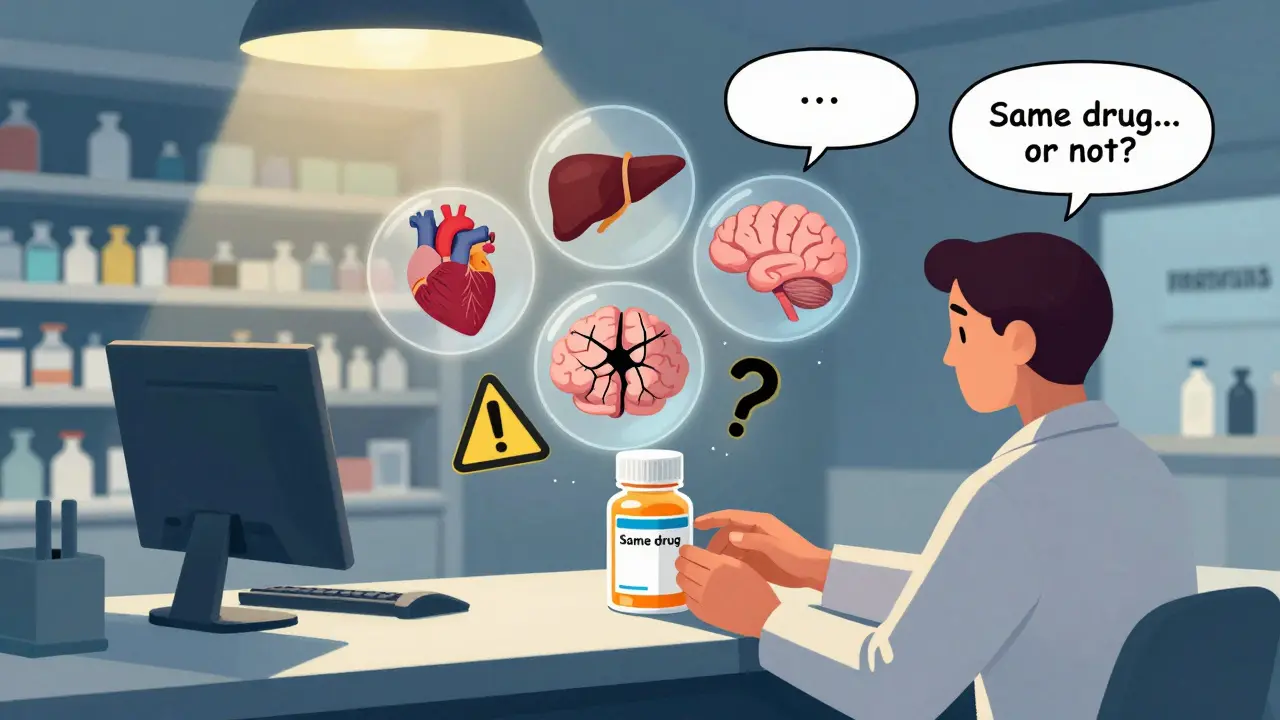
When you pick up a generic pill at the pharmacy, you’re getting the same active ingredient as the brand-name version - but not always the same safety story. Generic drugs make up 90% of prescriptions filled in the U.S., yet they don’t go through the same long, large-scale clinical trials before hitting the market. Instead, they’re approved based on proving they work the same way as the original drug. That’s efficient. But it also means some safety issues only show up after thousands, even millions, of people start taking them. That’s where post-market studies on generic drug safety come in.
Why Generic Drugs Need Extra Monitoring
Brand-name drugs spend years in clinical trials involving thousands of patients under controlled conditions. These trials look for side effects, interactions, and dosing issues. Generic drugs? They skip most of that. The FDA approves them based on bioequivalence - meaning they release the same amount of active ingredient into the bloodstream at the same rate as the brand-name drug. Sounds simple. But bioequivalence doesn’t tell you everything.What if the inactive ingredients - the fillers, coatings, or binders - cause a reaction in someone with a rare allergy? What if a tablet dissolves too slowly in an older adult with reduced stomach acid? What if a transdermal patch doesn’t stick properly, leading to inconsistent dosing? These aren’t theoretical. In 2022, the FDA recalled 1,247 generic drugs - 78% of all drug recalls that year - mostly due to quality issues like poor dissolution, inconsistent potency, or packaging defects.
Complex generics - like inhalers, injectables, or patches - are especially tricky. A small change in manufacturing can alter how the drug behaves in the body. A 2021 study in JAMA Internal Medicine found that 68% of serious adverse event reports for cardiovascular generics weren’t listed on the label at the time of approval. That means doctors and patients were flying blind.
How the FDA Tracks Problems After Approval
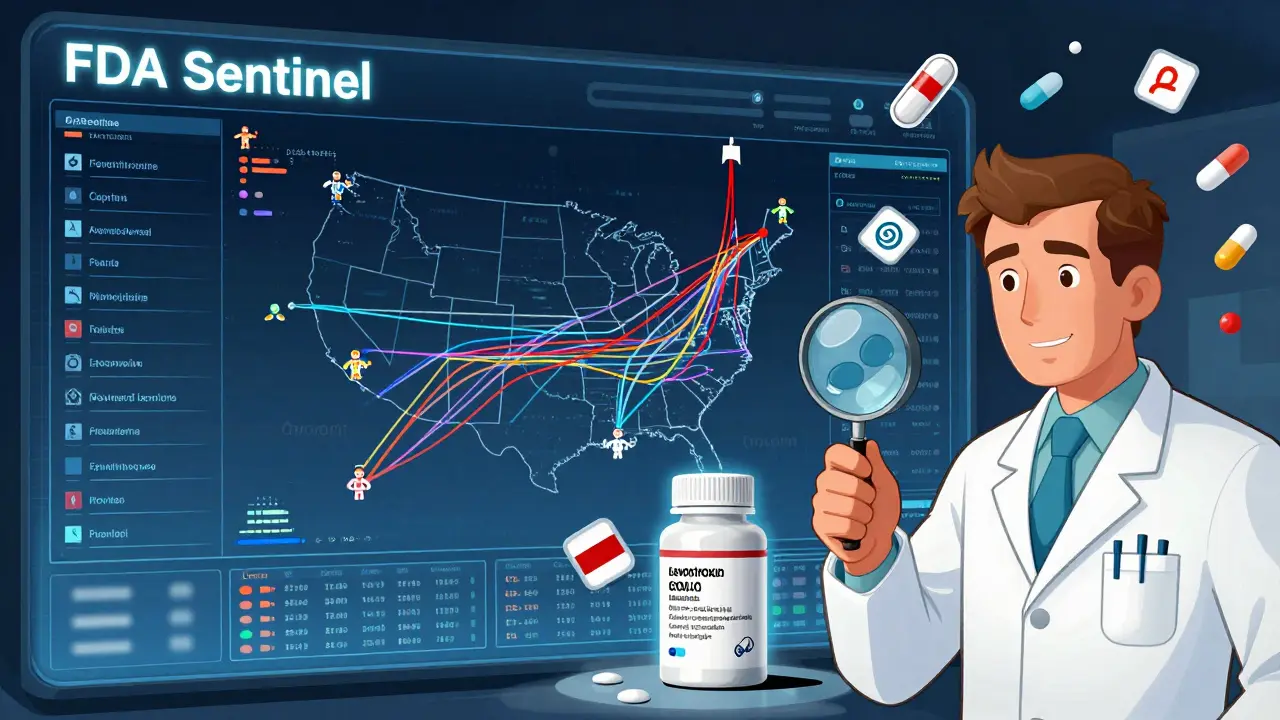
The FDA doesn’t just wait for complaints. It runs a real-time safety net called the Sentinel Initiative. Launched in 2008 and fully active by 2016, Sentinel analyzes health data from over 300 million patients across hospitals, clinics, and insurers. It looks for unusual spikes in hospital visits, lab abnormalities, or deaths linked to specific drugs.Doctors and pharmacists report problems too - through MedWatch, the FDA’s voluntary reporting system. In 2022, the agency received over 1.5 million adverse event reports. About 40% involved generic drugs. But here’s the catch: only 35% of those reports named the actual manufacturer. That makes it hard to know if the problem is with one company’s version or all of them.
That’s why the FDA uses multiple tools:
- Spontaneous reporting (MedWatch)
- Electronic health record mining (Sentinel)
- Prescription event monitoring
- Drug registries for high-risk medications
- Linking pharmacy and insurance claims to track outcomes
For example, if a sudden spike in heart palpitations shows up in patients taking levothyroxine, the FDA can drill down. Was it only one brand of generic? Did it happen after a switch from one manufacturer to another? That’s how they found that some patients had reactions after switching from one levothyroxine generic to another - even though both were labeled the same.
Who’s Responsible for Reporting Problems?
Generic drug manufacturers are legally required to report any serious adverse events to the FDA within 15 days. Less serious ones go in periodic reports. They must also update the FDA if they change their manufacturing process - even slightly. A change in the tablet coating? That’s a “CBE-30” supplement. A new supplier for the active ingredient? That’s a “Prior Approval Supplement.” No changes can happen without FDA review.But compliance isn’t perfect. In 2021, Teva Pharmaceuticals got a warning letter for failing to report adverse events properly. The result? A six-month delay in approving new generic products. That’s expensive. And it’s not just big companies. Smaller manufacturers often lack the staff or tech to run robust safety systems. A 2022 Tufts study found the average cost of running a pharmacovigilance system for a generic drug company is $1.2 million a year. Many small firms struggle to meet that.
What Patients and Providers Are Seeing
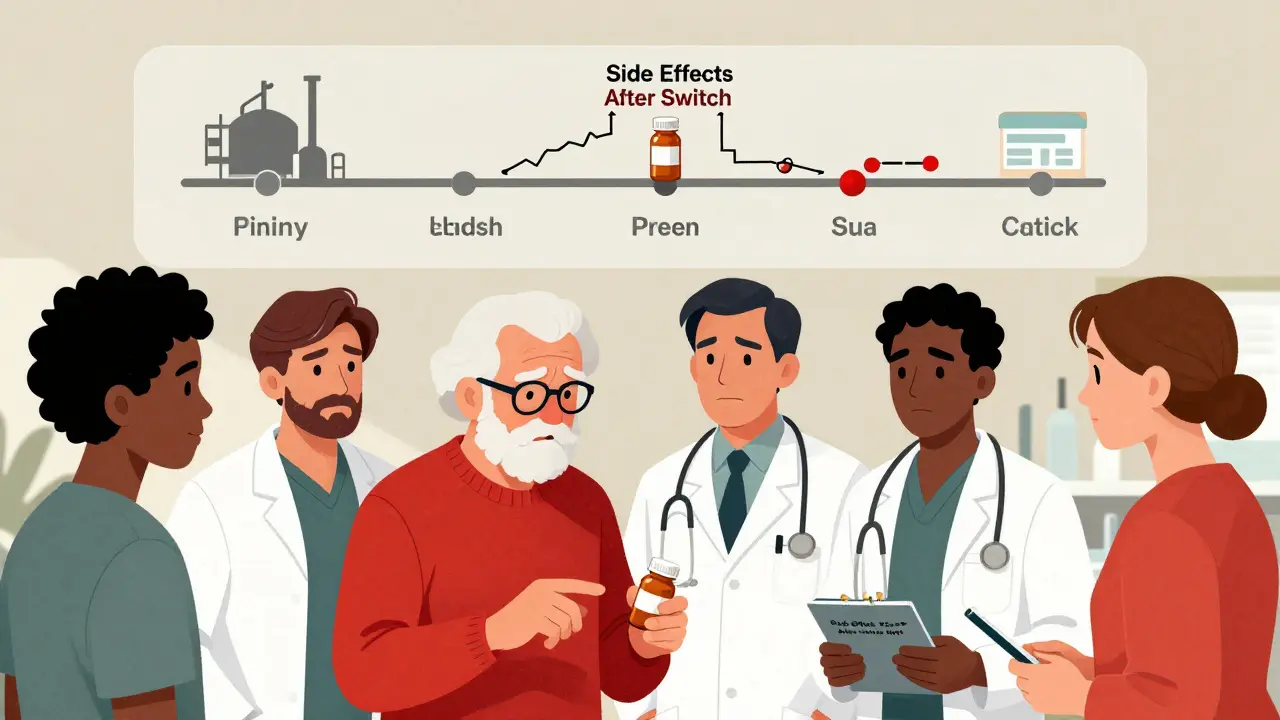
Most patients never notice a difference. A 2023 Kaiser Family Foundation survey showed 89% of people taking generics for high blood pressure or diabetes reported no issues. Cost savings mean more people stick to their meds - and that’s a win.But for some, the difference is real. A 2022 American Medical Association survey found that 42% of physicians had seen possible differences between brand and generic versions of narrow therapeutic index drugs - drugs where even a small change in dose can cause harm. Think thyroid meds, seizure drugs, blood thinners, or immunosuppressants.
Pharmacists are on the front lines. One pharmacist on Reddit shared that three patients developed palpitations after switching from one levothyroxine generic to another. All three needed dose adjustments. Another reported patients complaining of nausea or dizziness after switching to a new generic version of metformin - symptoms that vanished when they went back to the old brand.
Common patient complaints on MedWatch include:
- Transdermal patches falling off (27% of patch-related reports)
- Tablets dissolving too slowly or too fast (23%)
- Unexpected nausea or stomach upset (19%)
- Medication not working as well as before
These aren’t always the drug’s fault. But they’re signals the FDA can’t ignore.
The Big Gaps in the System
The system works - but it’s not perfect. Here’s why:- Manufacturer confusion: Patients rarely know which company made their generic. Pharmacists don’t always record it. That makes tracing problems nearly impossible.
- Fragmented manufacturing: One drug might be made by five different companies across three countries. If one has a quality issue, it’s hard to isolate.
- Limited data on vulnerable groups: Clinical trials for generics rarely include elderly patients, kids, or pregnant women. But those are the people who take these drugs the most.
- Slow response times: It can take months for a safety signal to turn into an action - especially if the FDA is waiting for more data.
Even experts disagree. Dr. Aaron Kesselheim from Harvard says the system is too fragmented. Dr. Janet Woodcock, former head of the FDA’s drug center, says the abbreviated approval process makes post-market surveillance essential. The FDA’s Howard Chazin says they’re using AI to find signals in the noise - and they’re getting better.
What’s Changing in 2025 and Beyond
The FDA is stepping up. In 2023, it launched GDUFA III - a new funding plan that includes $15 million specifically for generic drug safety surveillance. They’re also rolling out the Sentinel Common Data Model Plus, which now includes data on income, housing, and access to care - helping them understand if safety issues are tied to social factors.By 2025, the FDA plans to create product-specific surveillance plans for high-risk generics - like complex injectables or drug-device combos. They’re also testing blockchain to track each batch of generic drugs from factory to pharmacy. That way, if a problem pops up, they can trace it to the exact batch - not just the generic name.
For now, the best defense is awareness. If you switch generics and feel different - worse side effects, less effectiveness, new symptoms - talk to your doctor. Don’t assume it’s all in your head. Report it to MedWatch. And if you’re a provider, document the manufacturer when you prescribe. That tiny detail could save a life.
What You Can Do
You don’t need to be a doctor or regulator to help. Here’s how:- Keep track: Note the name of the generic manufacturer on your prescription label. It’s often printed on the bottle.
- Report changes: If you notice new side effects after switching generics, tell your doctor and file a report at MedWatch.
- Ask questions: If your pharmacist switches your generic without telling you, ask why. You have the right to know.
- Stay informed: Check the FDA’s Drug Safety Communications page. They issue alerts for generics too.
Generic drugs save billions and make medicine accessible. But safety doesn’t end at approval. It’s a continuous conversation - between patients, providers, and regulators. And every report matters.
All Comments
Vu L December 28, 2025
Nah, generics are fine. I've been on the same generic blood pressure med for 8 years. My body doesn't care if it's made in India or New Jersey. Stop scaremongering.
James Hilton December 29, 2025
America’s got the best drug safety system in the world 🇺🇸. If you’re complaining about generics, you probably just hate saving $20 a month. 🤷♂️💊
Debra Cagwin December 30, 2025
This is such an important conversation. So many people don’t realize how much trust we place in the system-and how many quiet, unseen people are working behind the scenes to keep us safe. Thank you for highlighting this.
Small details matter. Writing down the manufacturer name? That’s a simple act of self-advocacy that can literally save lives.
Hakim Bachiri December 30, 2025
I’ve had enough of this foreign-made junk!! FDA’s been bought out by Big Pharma and China!! My cousin’s uncle’s neighbor took a generic and his spleen exploded-true story!! You think they tell you that on the label?? NO!! They’re hiding it!!
Celia McTighe December 30, 2025
I switched my levothyroxine last month and felt like a zombie for two weeks 😥
Went back to the old one and boom-energy returned 🙌
Just wanted to say: if you feel off after a switch, it’s NOT in your head. Talk to your doc. And yes, I reported it to MedWatch 📝❤️
Ryan Touhill January 1, 2026
It’s fascinating how the entire pharmaceutical ecosystem is built on a foundation of statistical approximations and institutional trust. The notion that bioequivalence = clinical equivalence is a profound epistemological fallacy, especially when considering pharmacokinetic variability across diverse populations. The FDA’s reliance on passive reporting systems is, frankly, archaic.
Samantha Hobbs January 1, 2026
Wait so you’re saying I should write down the manufacturer name? Like on a sticky note? 😅 I just take the pill and go. Is that bad??
Nicole Beasley January 3, 2026
So if a patch falls off, is that a manufacturing defect or just bad luck? 🤔 I’ve had that happen twice. Also, what’s the best way to check if my generic has been recalled?
sonam gupta January 3, 2026
India makes the best generics in the world. USA crying because they can’t compete. You think your brand name drugs are safe? They kill more people than generics. Wake up
Julius Hader January 5, 2026
I don't care what the FDA says. If I feel weird after a switch, I'm going back to the brand. People who say 'it's all in your head' are the same ones who told smokers 'it's just a cough'.
Payton Daily January 6, 2026
This whole system is a lie. They approve generics because they don’t want to pay for real science. It’s like giving someone a fake Rolex and saying ‘it tells time the same’. But what if the second hand ticks backwards? Who’s gonna fix it? Nobody. We’re all just lab rats.
Kelsey Youmans January 6, 2026
The complexity of pharmacovigilance in the context of generic pharmaceuticals presents a significant challenge to public health infrastructure. While cost-efficiency remains a paramount consideration, the ethical imperative to ensure therapeutic consistency across diverse patient populations cannot be overstated.
Sydney Lee January 7, 2026
Let’s be honest: the FDA is a broken institution. They approved 1,247 faulty generics last year and called it ‘business as usual’. The real criminals aren’t the manufacturers-they’re the bureaucrats who sit in their D.C. offices while people suffer. I’ve seen it. I’ve lost patients to this. And no one gets fired.
oluwarotimi w alaka January 9, 2026
America always think they best but generics from Nigeria and India save more life than your fancy brand pills. You don't know what real medicine is. Your system is sick