
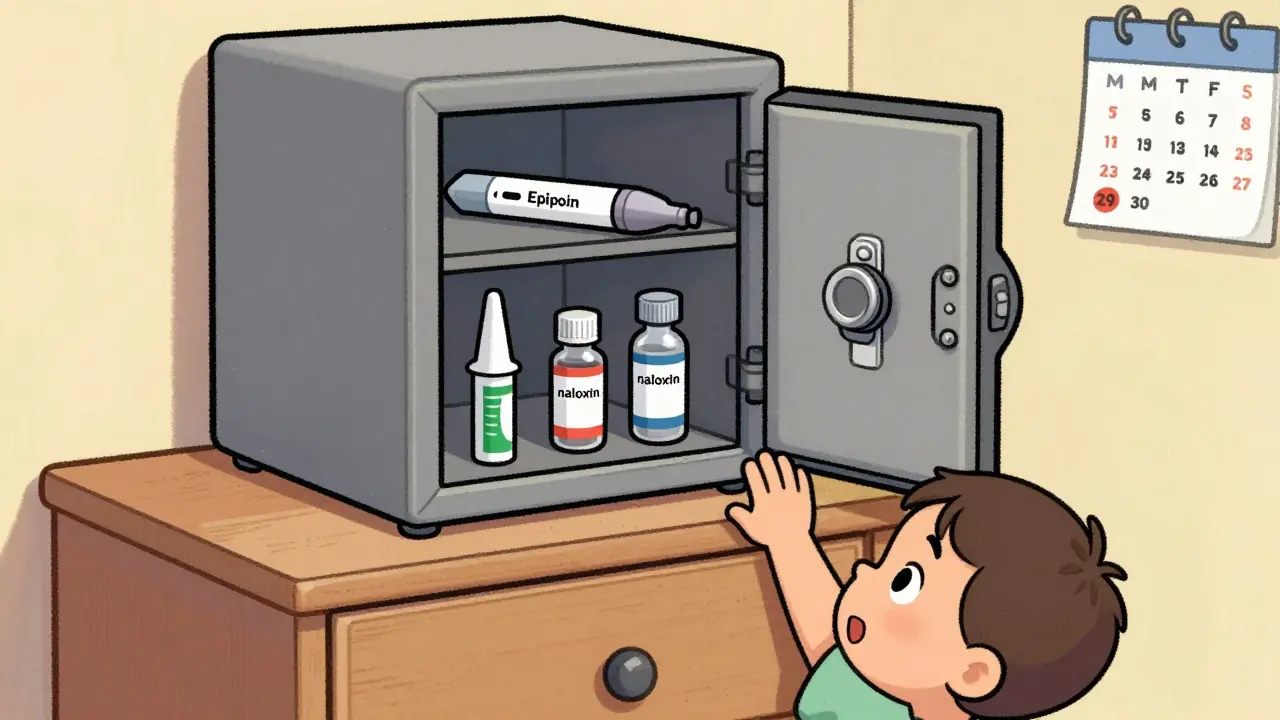
Keeping emergency medications like epinephrine, naloxone, or nitroglycerin within reach during a crisis - while keeping them locked away from kids, pets, or curious hands - isn’t just smart. It’s life-saving. But it’s also tricky. Too locked up, and you risk delaying care. Too loose, and you risk misuse, spoilage, or worse. The answer isn’t about choosing one over the other. It’s about finding the right balance for your situation.
Know What You’re Storing
Not all emergency meds are the same. Epinephrine auto-injectors (like EpiPens) work best at room temperature. If you refrigerate them, the device can get damaged. Naloxone (Narcan) nasal spray is also fine at room temp. But insulin for diabetic emergencies? That needs to stay cool. If you’re storing multiple types, you can’t treat them all the same.Check the label. Every prescription or OTC emergency med comes with storage instructions. If it says "store at 68°F to 77°F," that’s your sweet spot. Avoid windowsills, dashboards, or bathroom cabinets. Heat and humidity ruin medicine. The FDA found that only 43% of prescription labels clearly state storage needs - so don’t assume. If you’re unsure, call the pharmacy.
Home Storage: Locked But Not Locked Away
In a home with kids, pets, or visitors, the safest bet is a locked box or cabinet - but not buried in a closet. Think: high shelf in the master bedroom, inside a dresser with a childproof lock, or a small medicine safe under the sink. The key is: immediate access for adults, but out of reach for children.Medicine safes are cheap - under $30 on Amazon or at local pharmacies. Look for ones with a key or combination lock, not just a latch. A simple lockbox from a hardware store works too. The goal isn’t to outsmart a burglar. It’s to outsmart a 3-year-old who thinks the colorful pill bottle is candy.
Don’t keep emergency meds in the kitchen or bathroom. Heat from the stove or steam from the shower can weaken them. Don’t leave them on the counter "just for a minute." That minute turns into an hour, then a day. The CDC’s PROTECT Initiative says: "Put medicines away every time." It’s not a suggestion. It’s a rule.
For Caregivers: Schools, Daycares, and Public Spaces
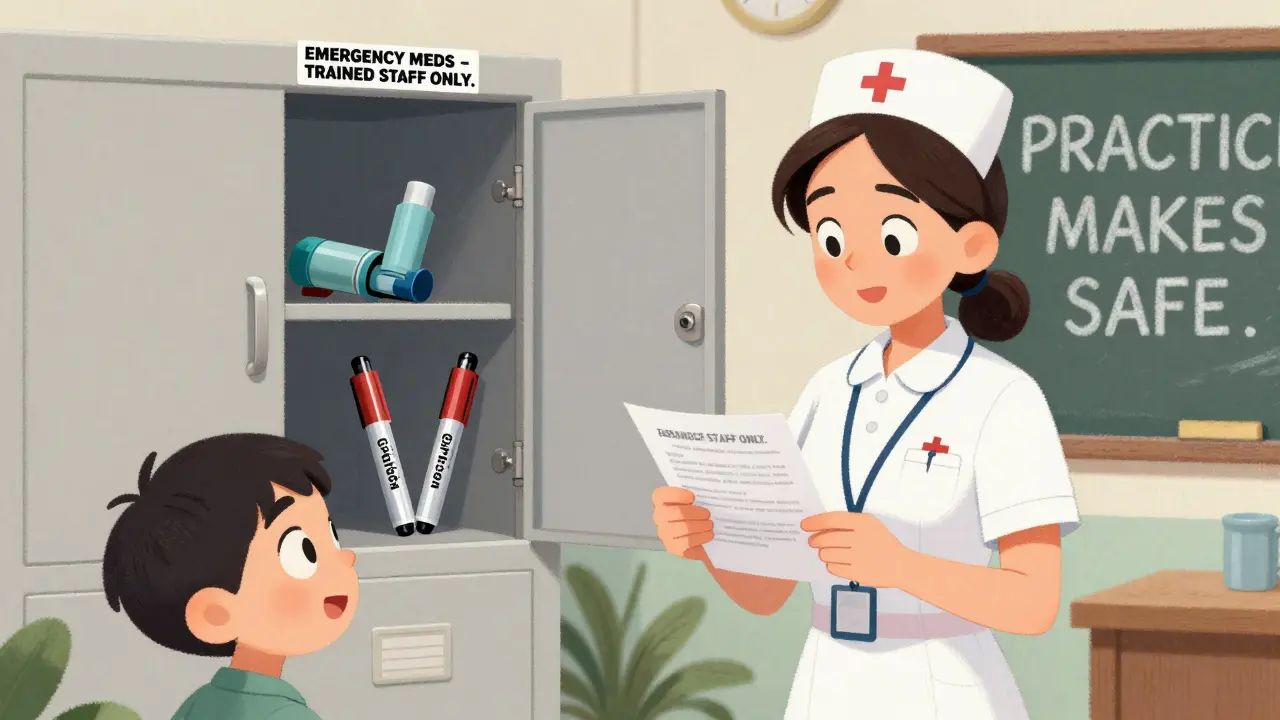
If you’re a parent, teacher, or caregiver, your emergency meds - like an EpiPen or albuterol inhaler - need to be accessible to trained staff, but not to kids. Most childcare centers follow state rules that require medications to be stored in a locked container, but within arm’s reach of staff during active supervision. That means a locked drawer in the nurse’s office, or a labeled bag clipped to a staff member’s lanyard.Some schools let kids carry their own inhalers or EpiPens. That’s fine - if they’re trained, responsible, and the school has a written plan. But if your child is young or has a history of losing things, keep the backup in the nurse’s office - locked, labeled, and checked monthly.
Pro tip: Always have a spare. One study found that 1 in 5 schools ran out of epinephrine during a reaction because the only one was being used. Keep one in the main office, one in the classroom, and one with the child - if allowed.
On the Go: Cars, Travel, and EMS
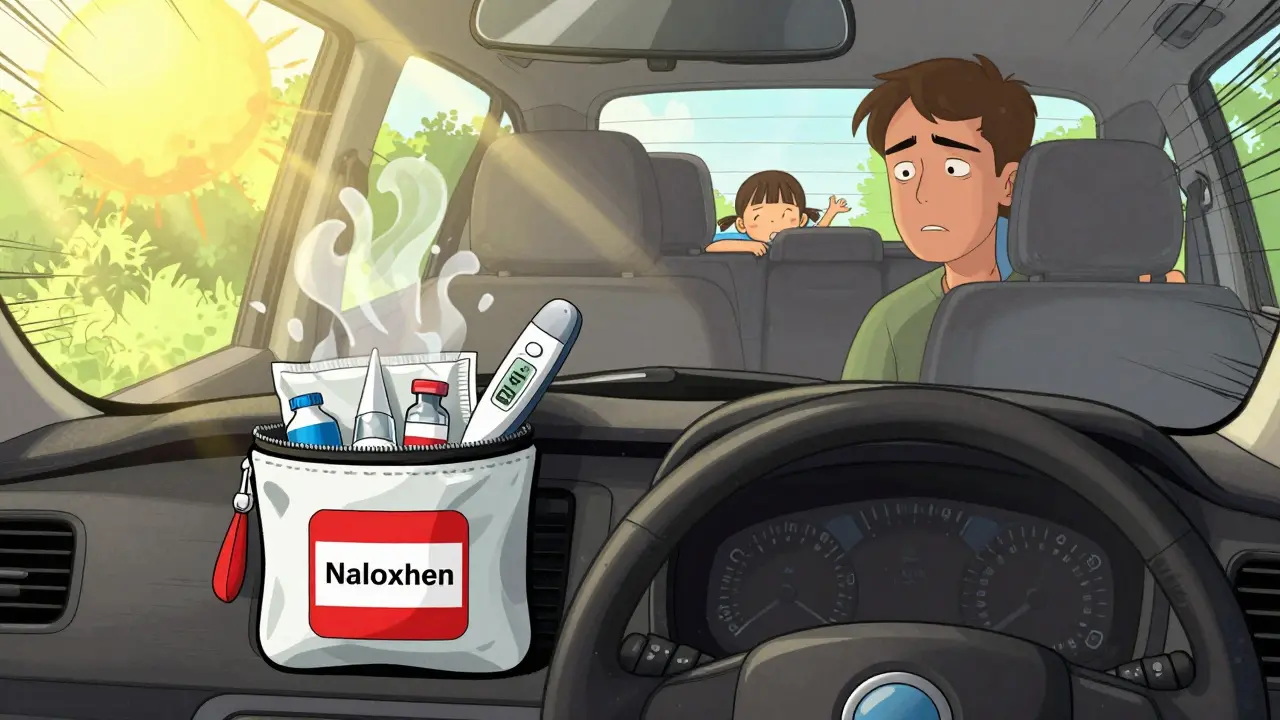
If you drive someone with a chronic condition - or if you’re an EMS provider - your car is a high-risk zone. In summer, a car can hit 140°F. That’s way above the 104°F limit for most meds. A locked glove compartment? Still too hot. A cooler with a cold pack? Better. But only if you’re not leaving it in the sun.Use a small insulated pouch with a reusable ice pack. Keep it in the cabin, not the trunk. For EMS vehicles, regulations require lockable cabinets with temperature logs. For personal use, you don’t need that level of tech. Just a sturdy box, a cold pack, and a reminder to check the temp before each trip.
And if you’re carrying naloxone in your car - good. But make sure your spouse, teen, or ride-share driver knows where it is. Emergency access isn’t just about you. It’s about who else can act if you’re unconscious.
Controlled Substances: The DEA Rules
If your emergency med is a controlled substance - like an opioid painkiller for severe flare-ups - federal rules apply. The DEA says these must be stored in a substantially built, locked cabinet. Not a drawer. Not a box with a rubber band. A real lock. And if it’s Schedule II (like oxycodone), it must be kept separate from other meds.Many people don’t realize this. They think, "It’s just one pill for bad days." But the DEA counts every pill. Loss or theft of even one controlled substance must be reported. That’s why pharmacies use locked cabinets. That’s why hospitals use electronic dispensing systems. At home, you don’t need a high-tech vault. But you do need a lock that can’t be opened with a butter knife.
Temperature Matters More Than You Think
Medications aren’t like wine. They don’t improve with age - and they don’t handle heat well. Epinephrine loses potency if it gets too hot. Naloxone can break down in direct sunlight. Insulin clumps. Antibiotics become useless.Here’s what you need to know:
- Room temperature: 68°F-77°F (20°C-25°C)
- Acceptable range: 59°F-86°F (15°C-30°C)
- Above 104°F? That’s dangerous.
- Refrigerated meds: 36°F-46°F (2°C-8°C)
Use a simple digital thermometer in your storage box. If it hits 90°F in your car or 85°F in your bathroom, it’s time to move the meds. The FDA-approved TempTraq device costs about $25 and sends alerts to your phone - but even a $5 thermometer from Walmart works.
Training and Practice: Don’t Wait for the Emergency
Knowing where your meds are isn’t enough. Someone else needs to know too. And they need to know how to use them.Practice with your family. Show your partner how to open the lockbox. Let your teen hold the EpiPen (don’t activate it - just practice the motion). Teach your neighbor where the naloxone is in your house. The National EMS Survey found that 17.3% of responders had delays because no one knew where the meds were stored.
Keep a printed card inside the box: "Emergency Medication: Epinephrine Auto-Injector. Location: Locked drawer in bedroom. Use: Press against thigh until click. Call 911 after." Simple. Clear. No jargon.
What Not to Do
Avoid these common mistakes:- Storing meds in the original pill bottle with no label - you won’t know what it is in a panic.
- Leaving meds in a purse or backpack - too easy to lose or steal.
- Using a combination lock you forget - write it down, but keep it separate.
- Sharing meds between family members - even if symptoms seem the same.
- Ignoring expiration dates - epinephrine expires in 12-18 months. Replace it.
What’s New in 2026
The CDC is rolling out updated home storage guidelines in late 2024, focused on balancing child safety with emergency access - especially for naloxone and epinephrine. More states are requiring schools to stock naloxone. And smart lockboxes are starting to appear - ones that send alerts when opened, or unlock only when a code is entered by a registered user.But the biggest change isn’t tech. It’s mindset. Emergency meds aren’t just supplies. They’re tools for survival. And like any tool, they need to be ready - not hidden, not forgotten, not expired.
Final Checklist
Here’s what to do today:- Find all emergency meds in your home.
- Check each label for storage instructions.
- Move them to a locked, cool, dry place - not the bathroom or kitchen.
- Label the container clearly: "EPINEPHRINE - EMERGENCY USE ONLY"
- Teach at least one other person how to find and use them.
- Set a reminder to check expiration dates every 3 months.
- Keep a spare in your car, bag, or workplace if needed.
Security isn’t about fear. It’s about control. Control over when and how your medicine is used. Control over your family’s safety. Control over your peace of mind. Get it right, and you’re not just storing pills. You’re storing time - the time it takes to save a life.
All Comments
Damario Brown January 14, 2026
bro i keep my epipen in my sock drawer lmao. kid thinks it’s a crayon. last week he tried to draw a dragon on the wall with it. not even a joke. called 911 twice. now it’s in a lockbox under my bed. the one that looks like a book. yeah, i know it’s dumb. but it works.
sam abas January 15, 2026
you missed the real issue here. nobody talks about how the FDA’s labeling standards are a joke. 43%? that’s not a failure of storage-it’s a failure of regulatory oversight. if the label doesn’t say ‘don’t leave it in a hot car’ then why should i assume it’s dangerous? it’s the same logic that lets pharmaceutical companies sell insulin without temperature warnings. capitalism kills people. and you’re all just talking about lockboxes like that fixes systemic neglect.
John Pope January 16, 2026
let’s be real-this isn’t about medicine. it’s about control. we lock things up because we’re terrified of chaos. of unpredictability. of losing the illusion that we can manage death. epinephrine isn’t a tool-it’s a mirror. it reflects our fear that one mistake, one second of hesitation, one unlocked drawer… could end someone we love. so we build cages. we call it safety. but really? we’re just trying to outrun grief.
Clay .Haeber January 18, 2026
oh wow. a 30-dollar lockbox. how avant-garde. i suppose you also store your insulin in a velvet pouch with a tiny gold key? darling, if you’re still using analog solutions in 2026, you’re part of the problem. there are smart lockboxes now that auto-unlock via Bluetooth when your phone is within 5 feet, log every access, and send alerts to your emergency contacts. if you’re not using tech like that, you’re not saving lives-you’re just doing a really expensive version of guesswork.
James Castner January 19, 2026
While I appreciate the pragmatic structure of this guide, I must emphasize that the underlying philosophy of emergency medication storage transcends mere logistical optimization. It is a metaphysical commitment to human dignity. To store a life-saving agent with care is to affirm the intrinsic value of each individual’s right to survival. The lockbox is not a container-it is a covenant. And every time we ensure accessibility without compromising safety, we participate in the sacred act of preserving temporal continuity against the encroachment of entropy. This is not merely protocol. It is ethics made tangible.
Adam Rivera January 20, 2026
just wanted to say-this post saved my sister’s life. we had her epi pen in the bathroom cabinet for years. steam ruined it. she had a reaction last year and we didn’t realize it was expired. now we keep it in a locked drawer in the bedroom with a sticky note that says ‘PUSH HARD, HOLD 10 SECONDS’. my 7-year-old knows the code to the lock. we practice every sunday. thanks for the reminder. this stuff matters.
lucy cooke January 21, 2026
Oh, darling, you’re all so… quaint. A lockbox? Really? In London, we use biometric safes that sync with the NHS app. If you’re not embedding emergency meds into a smart home ecosystem, you’re not just behind-you’re dangerously negligent. And don’t get me started on the absurdity of ‘checking expiration dates every three months.’ That’s not diligence. That’s performative hygiene. The real solution is systemic: make all epinephrine auto-injectors non-expiring through reformulation. But no, let’s just keep pretending a $5 thermometer is the answer.
Trevor Whipple January 22, 2026
you people are overcomplicating this. if you got a kid that’s dumb enough to open a lockbox, you got bigger problems than meds. i keep mine in the glovebox. if i’m dead, who cares if the kid takes it? they’ll probably just eat it and puke. problem solved. also, why are we acting like naloxone is a magic wand? it ain’t. it’s just a drug. stop making it a cult thing.
Scottie Baker January 24, 2026
you think a lockbox stops kids? my nephew opened my safe with a butter knife. i swear to god. he’s five. i thought it was a toy. now i have a biometric safe with a fake bottom. the real meds are under the false panel. the fake ones? expired antihistamines. the kid took ‘em. threw up. cried. learned his lesson. also, i keep a spare in my wallet. if i’m unconscious, someone’s gotta know to check my front pocket. don’t be a hero. be prepared.
Anny Kaettano January 24, 2026
I’ve worked in pediatric ERs for 14 years. The most common reason families lose time in anaphylaxis? They don’t know where the EpiPen is-even if they own one. The second most common? They’re afraid to use it because they’re scared they’ll hurt the kid. This post? It’s not just about storage. It’s about normalization. Practice with your kids. Let them touch it. Let them hear the click. Make it ordinary. Because when panic hits, ordinary is the only thing that saves you.
Diana Campos Ortiz January 26, 2026
thank you for writing this. i’m a single mom of two with a kid who’s allergic to peanuts. i used to keep the epi pen in my purse. lost it twice. now it’s in a labeled lockbox on the nightstand. i even printed a card with the steps and taped it to the front. my 6-year-old knows the code. she says it’s her ‘superhero box.’ i cried when she said that. this isn’t just safety. it’s love in action.
Jesse Ibarra January 27, 2026
you’re all missing the point. this isn’t about lockboxes or thermometers. it’s about privilege. if you can afford a smart safe, a cold pack, and time to check expiration dates, you’re already in the top 10%. most people don’t even have running water. the real crisis isn’t storage-it’s that we’ve turned healthcare into a DIY hobby for the wealthy. if you want to save lives, fix the system. not your drawer.
laura Drever January 27, 2026
epipen in the car? lol. you know how many people die because their meds melted in the glovebox? i’ve seen it. and you’re telling me to use a walmart thermometer? go ahead. let me know how that works when the temp hits 110 and the epinephrine turns to soup. also, why are you not mentioning that 70% of schools don’t even have naloxone? this post is like giving someone a bandaid and calling it a cure.
Randall Little January 29, 2026
so… you’re saying a $30 lockbox is the solution to a $2000 drug crisis? i’m curious-what’s the cultural logic behind this? why do we treat emergency meds like they’re jewelry instead of medical tools? and why is the burden of responsibility always on the individual? if we had universal healthcare, maybe we wouldn’t need to turn our homes into pharmaceutical vaults. but nope. let’s just blame parents for not locking things up. classic.