

Every year, thousands of patients in U.S. hospitals are harmed-not because of their illness, but because of a medication error. Many of these errors involve high-alert medications: drugs that can cause serious injury or death even when used in small mistakes. The good news? Most of these errors can be stopped before they reach the patient-by doing a proper independent double check. The bad news? Too often, double checks are done wrong, or skipped entirely, making them useless-or worse, giving a false sense of safety.
What Makes a Medication High-Alert?
Not all medications are created equal when it comes to risk. A high-alert medication isn’t necessarily the most powerful or expensive drug. It’s one where a small mistake leads to big consequences. Think insulin, heparin, potassium chloride, or chemotherapy drugs. A wrong dose of insulin? That’s a coma. A misprogrammed IV heparin pump? That’s internal bleeding. A wrong concentration of potassium? That’s cardiac arrest. The Institute for Safe Medication Practices (ISMP) keeps the most widely used list of these drugs. Their 2024 update identifies 19 categories that require special safeguards. Among them:- IV insulin (both infusions and bolus doses)
- Neuromuscular blocking agents (paralytics like succinylcholine)
- Potassium chloride concentrate (1 mEq/mL or higher)
- Potassium phosphate concentrate (1 mEq/mL or higher)
- Heparin infusions (anything above 100 units/mL)
- Chemotherapy agents (all forms)
- Injectable narcotic patient-controlled analgesia (PCA) pumps
- Total parenteral nutrition (TPN) and lipids
- Direct thrombin inhibitors (like argatroban)
- Sodium chloride solutions above 0.9%
What Is an Independent Double Check (IDC)?
An independent double check isn’t two people standing next to each other nodding at a label. It’s not one person reading the label while the other just signs off. It’s not even two nurses checking the same screen together. According to the Veterans Health Administration (VHA) Directive 1195, updated October 2024, an independent double check is:A process that occurs prior to medication administration in which two licensed health care clinicians, alone and apart from each other, check and then compare results for each component of the medication order, ensure clinical appropriateness in the context of the patient’s plan of care, and verify the pump settings, as applicable.That means:
- One clinician verifies the medication, dose, route, time, and patient identity-by themselves.
- The second clinician does the same-without hearing what the first person saw or said.
- Only after both have completed their checks do they compare notes.
What Exactly Do You Check During a Double Check?
A good double check doesn’t just confirm the label. It confirms five critical elements, as required by VHA and adopted by most major health systems:- Right patient: Two unique identifiers-like name and date of birth. Not room number. Not first name.
- Right medication: Match the drug name on the label to the eMAR (electronic Medication Administration Record). Watch for look-alike/sound-alike drugs like hydralazine vs. hydroxyzine.
- Right dose: Verify the strength and amount. Is that vial 10 mEq/mL or 100 mEq/mL? Is the pump set to 5 units/hour or 50?
- Right route: Is this supposed to be IV, IM, or oral? Giving potassium IV instead of oral can kill.
- Right time: Is this dose due now? Is it scheduled every 6 hours or as needed? Giving it too early or too late can be dangerous.
- Pump settings (for infusions)
- Calculation of dose (especially for weight-based meds)
- Expiration date
- Compatibility with IV fluid
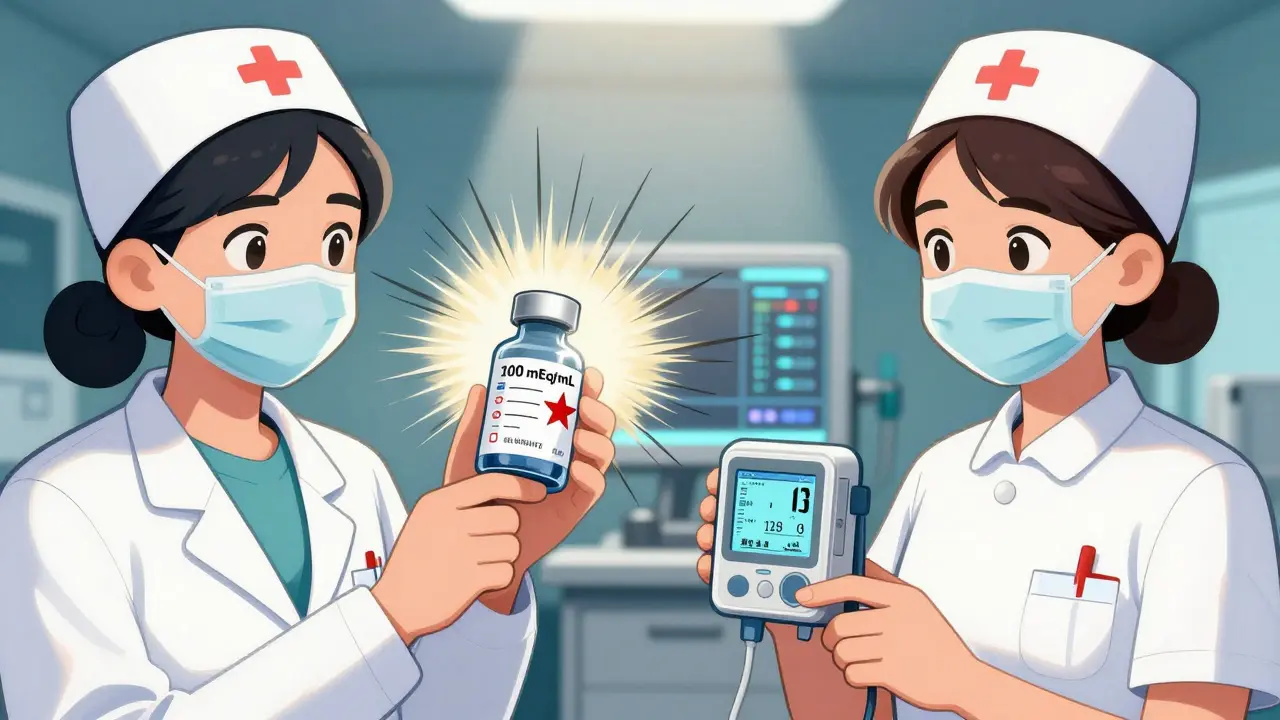
Why Do So Many Double Checks Fail?
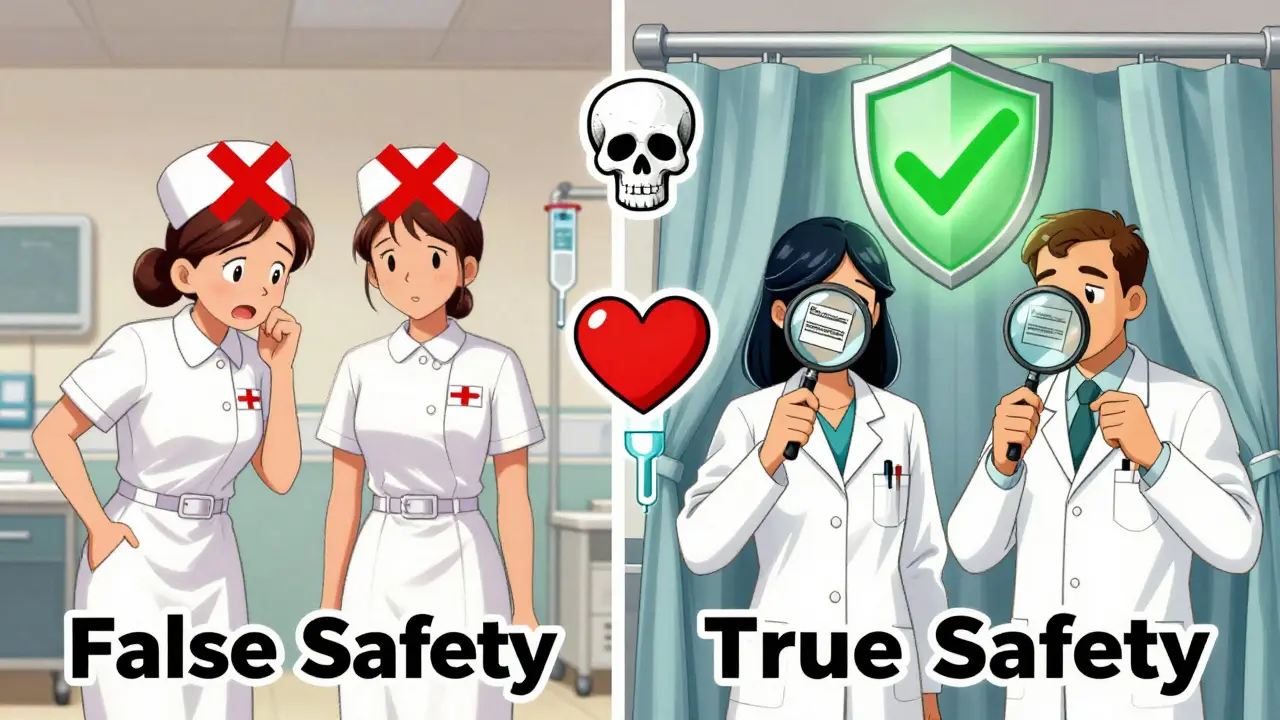
The ECRI Institute found that properly done independent double checks prevent 95% of errors. But poorly done? They stop only 40%. Why the gap? The biggest problem? Simultaneous checking. That’s when two people check the medication at the same time, side by side. One says, "Is this 5 units?" The other says, "Yeah, looks right." They don’t verify independently-they just agree. That’s not a double check. That’s a nod. Another issue? Time pressure. Nurses report that in fast-paced units like the ER or ICU, there’s no time to wait for a second person. One nurse on Reddit wrote: "I’ve caught 3 critical errors in 6 months through real double checks. But I’ve seen 12 rushed ones where the second person just signed without looking." Then there’s training. Many hospitals hand out a policy and say, "Do double checks." But they don’t train staff on what "independent" means. A 2021 ISMP study found 38% of errors came from unclear or inconsistent double-check procedures. And documentation? If you don’t document both signatures in the eMAR, it didn’t happen. At Magnet-recognized hospitals, 78% now require dual electronic signatures to close the loop.Which Medications Really Need a Double Check?
Here’s the truth: Not every high-alert medication needs a manual double check. The ISMP says it themselves: "Manual independent double checks are not always the optimal strategy." The best approach? Use them only for the highest-risk situations. Experts like Dr. Robert Stein from the VHA and David Mayer from ECRI recommend focusing IDCs on:- IV insulin (especially bolus doses)
- IV heparin infusions
- Chemotherapy infusions
- Neuromuscular blockers
- Potassium chloride concentrate
- PCA pumps for opioids
How to Build a Real Double-Check System
If you’re responsible for medication safety, here’s how to do it right:- Identify your high-alert meds: Start with the ISMP 2024 list. Then look at your own error reports. Which drugs caused the most harm in your unit?
- Define the process: Write down exactly what each person must check. Don’t say "verify the dose." Say "compare the ordered dose to the vial label and the eMAR, and confirm the concentration matches the protocol."
- Train and test: Don’t just hand out a handout. Run a 2-hour competency session. Use real-life scenarios. Require a passing score. Cleveland Clinic requires 95% on their module.
- Build in time: At Mayo Clinic, staffing models include time for double checks. If you don’t plan for it, it won’t happen.
- Use technology: Implement eMAR systems that require dual electronic signatures. Use smart pumps with DERS. Automate the easy stuff so people can focus on the hard stuff.
- Audit and improve: Randomly audit 10% of double checks each month. Are they independent? Are they complete? Are they documented?
What’s Changing in 2025?
The landscape is shifting. The Joint Commission’s 2024 National Patient Safety Goal requires hospitals to have formal safeguards for high-alert medications. CMS is watching. The FDA’s Safe Use Initiative is pushing harder on insulin, opioids, and anticoagulants. New tools are coming. AI-assisted verification is being piloted at 12% of academic medical centers. Risk-stratified checks are being tested-stricter checks for patients with kidney failure, for example. And by 2028, ECRI predicts a 40% drop in manual double checks as technology takes over more of the verification. But human judgment will always be needed-for the most dangerous drugs, the most vulnerable patients, and the most complex situations.Final Thought: Safety Isn’t a Checklist. It’s a Culture.
A double check isn’t a box to tick. It’s a last line of defense. When done right, it saves lives. When done wrong, it gives false confidence. The goal isn’t to check every high-alert drug. The goal is to make sure that when a mistake happens-because mistakes do happen-it doesn’t reach the patient. That’s not just policy. That’s responsibility.What medications require a double check according to ISMP 2024?
According to the Institute for Safe Medication Practices (ISMP) 2024 High-Alert Medications List, medications requiring special safeguards-including independent double checks-include IV insulin, neuromuscular blocking agents, potassium chloride concentrate (1 mEq/mL or higher), potassium phosphate concentrate (1 mEq/mL or higher), heparin infusions above 100 units/mL, chemotherapy agents, injectable narcotic PCA pumps, total parenteral nutrition (TPN), direct thrombin inhibitors, and sodium chloride solutions above 0.9%. Not all require manual double checks; the recommendation is to use them selectively for the highest-risk drugs and situations.
What’s the difference between a double check and an independent double check?
A regular double check might involve two people looking at the same label together or one person reading aloud while the other nods. An independent double check (IDC) requires two licensed clinicians to verify the medication separately and silently-without discussing their findings-then compare results only after both have completed their own checks. This prevents confirmation bias and ensures errors are truly caught.
Can a pharmacist and nurse do a double check together?
Yes, but only if they perform the check independently. For example, the nurse verifies the patient, drug, dose, route, and time on their own. Then the pharmacist does the same, without hearing the nurse’s findings. Only after both have completed their independent checks do they compare and sign off. If they check together, it’s not independent-and doesn’t meet safety standards.
Why are double checks sometimes skipped in emergencies?
In emergencies like cardiac arrest or severe trauma, there may not be a second licensed clinician available. Many hospitals have protocols allowing single-check administration with immediate documentation and post-event review. The key is to minimize risk by using pre-filled syringes, smart pumps, and pre-approved emergency drug kits. After the event, the team reviews what happened to improve future responses.
Do all hospitals require double checks for the same medications?
No. While most follow the ISMP 2024 list as a baseline, individual hospitals customize based on their own error data, patient population, and resources. For example, the VHA requires double checks for all high-alert medications. Providence Health System limits them to specific categories listed on the MAR. WVU Medicine requires them for 10 key categories. The trend is moving toward targeted use-not blanket requirements.
What happens if a double check is not documented?
If a double check isn’t documented in the electronic medication administration record (eMAR) with both clinicians’ electronic signatures, it is considered not performed. In audits, undocumented checks are treated as violations. This can lead to disciplinary action, mandatory retraining, or even regulatory citations from The Joint Commission or CMS, especially if an error occurs.
All Comments
Josh Potter December 17, 2025
Bro, I've seen nurses double-check insulin with their eyes closed and still mess it up. It's not the checklist, it's the culture. Stop treating safety like a box-ticking ritual.
Jane Wei December 19, 2025
I work in the ICU and we only do full IDCs on chemo and heparin now. Smart pumps caught 90% of the rest. Honestly? Less manual checks, more tech.
Kent Peterson December 19, 2025
ISMP? Please. They're just bureaucrats who've never held a syringe. We don't need 19 categories-we need common sense. And no, I'm not signing off on a double-check when the ER is on fire.
Linda Caldwell December 19, 2025
I used to hate double checks. Then I caught a 100x potassium dose that was about to go in. That was the day I stopped seeing them as paperwork and started seeing them as armor.
Anna Giakoumakatou December 20, 2025
Ah yes, the sacred ritual of two professionals nodding at a vial while scrolling TikTok. Truly, the pinnacle of 21st-century patient safety. I'm sure the family will appreciate the ceremonial compliance.
Evelyn Vélez Mejía December 21, 2025
The tragedy is not in the medication error-it is in the institutionalized complacency that transforms a safeguard into a theater. The independent double check, when executed with fidelity, is not a procedure; it is an ethical covenant between caregiver and patient. To reduce it to a checkbox is to betray the very principle of non-maleficence.
Nishant Desae December 23, 2025
Hey everyone, I'm from India and we don't always have two nurses available, but we still try our best. We use checklists, ask patients to confirm their name, and if we're short, we pause and call for help. Safety isn't about resources-it's about heart. We can do better even with less.
Philippa Skiadopoulou December 23, 2025
The VHA definition is correct. Independent means independent. Simultaneous verification is not double checking. It is collusion.
Jigar shah December 23, 2025
I've been in hospitals where the double check was just the second person saying 'looks good' while typing their signature. It's not the policy that's broken-it's the training. We need simulations, not handouts.
Sam Clark December 24, 2025
The data is clear: targeted independent double checks on the highest-risk medications, combined with smart pump integration, reduce errors by over 60%. The goal is not uniform application-it is precision application. Let us not mistake diligence for dogma.
Salome Perez December 25, 2025
In my hospital, we train new staff by having them watch a video of a real near-miss-where a double check saved a child from a lethal potassium dose. That’s when it stops being policy and becomes personal. Culture change starts with stories, not bullet points.
Sachin Bhorde December 27, 2025
DERS + IDC = game changer. We cut errors by 70% after we stopped doing IDC on TPN and just used smart pumps. Now we focus on chemo and PCA. Also, dont forget to check the bag for particulates-seen too many cloudy TPN bags go in without a second look.
Pawan Chaudhary December 28, 2025
Just wanted to say thanks to everyone who does these checks-even when no one’s watching. You’re the quiet heroes keeping people alive. Keep going!