
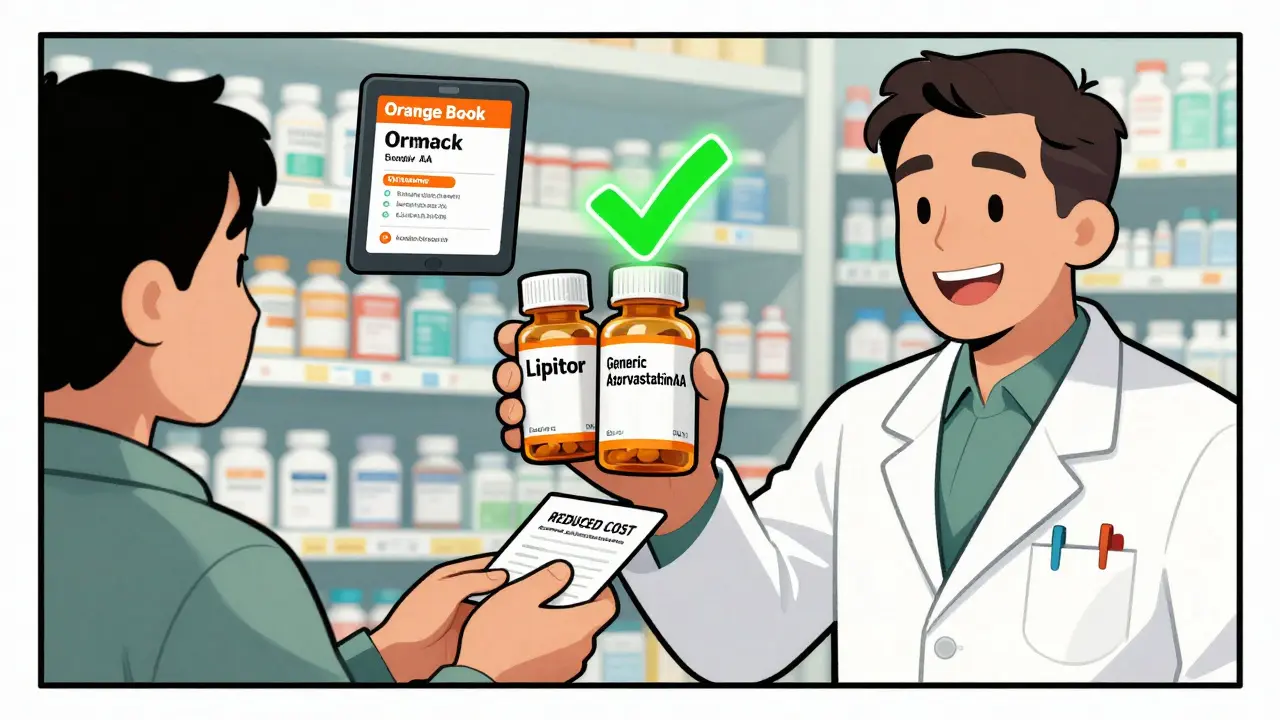
When you pick up a prescription at the pharmacy, you might not realize that a legal system is quietly deciding whether you get the brand-name drug or a cheaper generic. That system? FDA therapeutic equivalency codes. These aren't just technical labels-they're the legal backbone of drug substitution in the U.S., and they directly affect your out-of-pocket costs and access to medicine.
Every generic drug approved by the FDA gets a code, usually two letters like 'AA' or 'AB'. These codes tell pharmacists and state boards whether the generic can legally replace the brand-name version. It's not enough that the generic has the same active ingredient. The FDA requires proof that it works the same way in your body, delivers the same dose at the same rate, and produces the same clinical effect. Only then does it earn an 'A' rating-and the legal right to be swapped in without a doctor's approval.
What the 'A' and 'B' Codes Really Mean
The first letter of the TE code is the most important. If it's an 'A', the generic is considered therapeutically equivalent to the brand-name drug. That means you can swap it without worry. If it's a 'B', the FDA says there's not enough evidence to confirm it works the same way. You might still get the 'B' drug if your doctor writes for it specifically, but your pharmacist can't substitute it on their own.
Here’s how it breaks down:
- 'AA' = Immediate-release oral pills with no bioequivalence concerns. These are the most common generics-think generic versions of Lipitor or metformin.
- 'AB' = Products that had initial bioequivalence questions but later proved equivalent. This often happens when the FDA gets more data after approval.
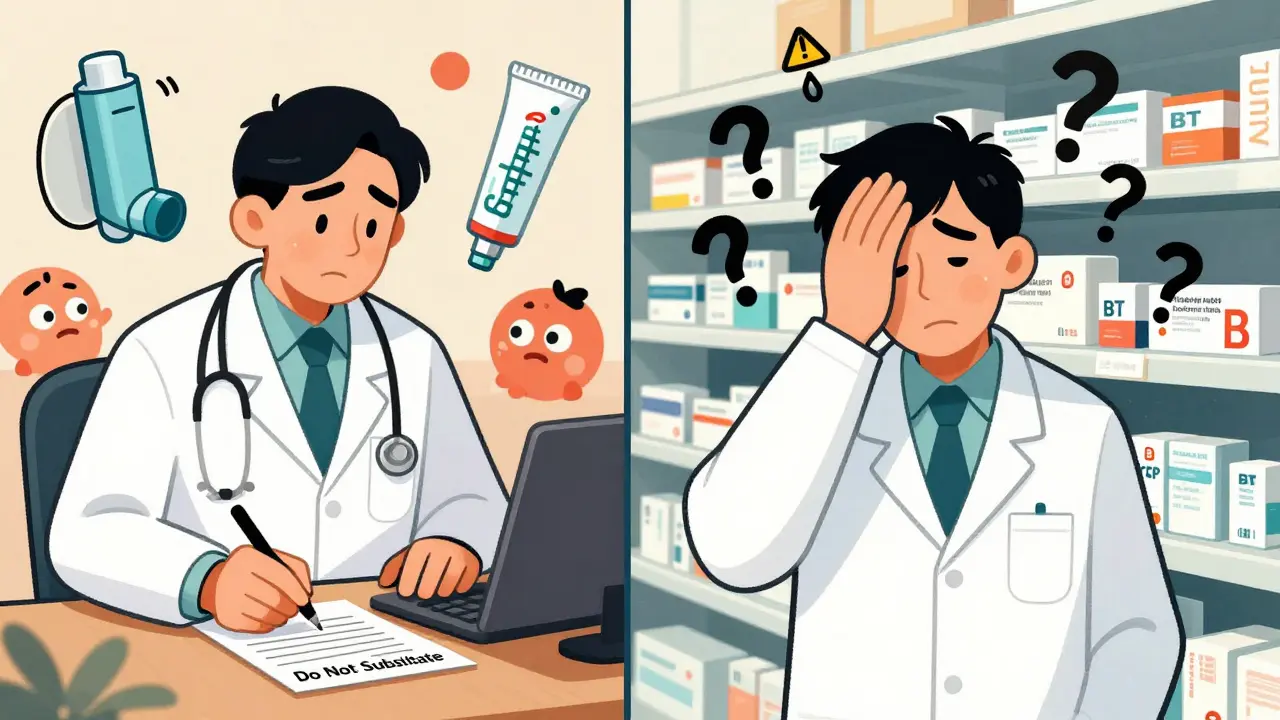
- 'B' = Any code starting with 'B' means substitution isn't allowed under state law. This includes 'BC' (extended-release), 'BD' (bioequivalence problems), 'BT' (topical creams), 'BN' (nebulized inhalers), and others.
There's a reason 'B' codes exist. Some drugs are incredibly complex. A cream, an inhaler, or a long-acting injection doesn't behave the same way in the body as a simple pill. Two generics of the same drug might have different inactive ingredients or manufacturing processes that affect how the medicine is absorbed. The FDA doesn't assume they're the same-it requires hard data.
How the Law Makes Substitution Real
The FDA assigns the codes, but the law that lets pharmacists swap drugs comes from the states. All 50 states base their substitution rules on the Orange Book-the FDA's official list of therapeutic equivalency ratings. If a drug has an 'A' code, state laws almost always allow substitution. If it's a 'B', substitution is prohibited.
For example, California's pharmacy law says pharmacists can substitute only if the generic has an 'A' rating. New York requires pharmacists to check the current Orange Book before swapping. In Texas, the law is even stricter: if the prescriber writes "Do Not Substitute," the pharmacist must honor that-even if the generic has an 'A' code.
This legal patchwork means your ability to get a generic depends on where you live. But the common thread? The FDA's TE code is the gatekeeper. Without it, state laws wouldn't have a clear standard to follow.
Why This System Saves Billions
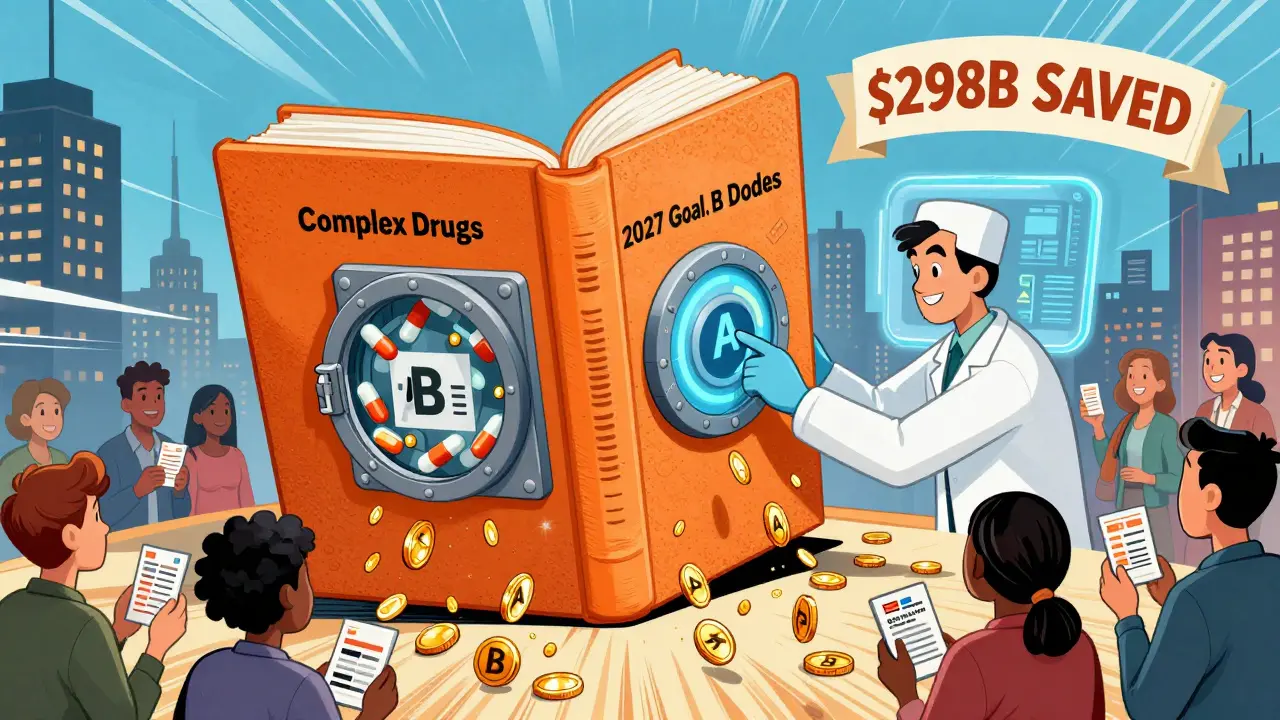
Therapeutic equivalency codes aren't just about safety-they're about cost. Since the system was expanded after the 1984 Hatch-Waxman Act, generics have saved the U.S. healthcare system more than $1.7 trillion. In 2022 alone, drugs with 'A' codes saved $298 billion.
How? When a generic gets an 'A' rating, pharmacists can swap it automatically. That drives competition. Brand-name companies lose market share fast. Prices drop. Patients pay less. Pharmacies benefit. Insurers save money. It’s a ripple effect that lowers costs at every level.
But here's the catch: only 62% of FDA-approved drugs have 'A' codes. That means nearly a quarter of approved generics still can't be substituted. Many of those are complex drugs-inhaled steroids, injectable biologics, topical treatments for eczema or psoriasis. These are expensive to develop, and proving bioequivalence is harder than with a simple pill.
The Hidden Struggle Behind 'B' Codes
You might wonder: if a drug is FDA-approved, why isn't it automatically 'A'? The answer is messy. Sometimes, the generic manufacturer doesn't submit enough data. Other times, the science is still evolving. A cream that works on one person's skin might not work the same on another's. An inhaler's particle size matters. A slow-release tablet's coating affects absorption.
That's why 'B' codes persist. In 2023, 24.3% of listed products carried 'B' ratings. Pharmacists report real hesitation. A 2023 survey found 68% of pharmacists avoid substituting 'BT' (topical) or 'BN' (nebulizer) products because they’ve seen patients have inconsistent responses.
Brand-name companies have used this uncertainty to their advantage. In 2022, the FDA received 1,247 citizen petitions challenging TE codes-up 17% from the year before. Many were filed to delay generic entry. The system, while effective, is under pressure.
What’s Changing Now?
The FDA knows the system needs updating. In 2023, it launched a major push to reduce the number of 'B' codes. Its Complex Generic Drug Initiative is focused on improving testing methods for inhalers, creams, injections, and other tricky products.
The goal? Get 'B' code products down from 24.3% to under 15% by 2027. That means more generics will qualify for substitution, more patients will save money, and fewer people will be stuck with expensive brand-name drugs.
One big change: the FDA now accepts minor formulation differences-like different fillers or coatings-as long as the drug performs the same in the body. That opens the door for more generics to earn 'A' ratings.
Also, the Orange Book is now digital. Pharmacists can access it via API through their pharmacy systems. That means real-time updates. No more waiting for a printed book. If a new 'A' code is assigned, your pharmacy system gets the update automatically.
What You Need to Know as a Patient
If your prescription says "brand necessary," ask why. Is it because the drug has a 'B' code? Or is it just habit? Many doctors still default to brand names out of caution-even when a generic has an 'A' rating.
Check your pill. If you're on a generic, look at the name. If it's the same active ingredient as the brand, and your pharmacy didn't ask for permission to swap it, you're likely on an 'A' rated product.
And if you're switching from a brand to a generic, pay attention. Some people notice differences in side effects or effectiveness-even with 'A' rated drugs. That doesn't mean the code is wrong. It means your body reacts differently. Talk to your doctor or pharmacist. Don't assume it's a problem with the drug.
Bottom line: FDA therapeutic equivalency codes are the invisible hand that makes affordable generics possible. They're not perfect, but they're the best system we have. And they're getting better.
All Comments
Susan Kwan February 9, 2026
So let me get this straight - the FDA gives a drug an 'A' rating, states say 'go ahead and swap,' and somehow we still end up paying $400 for a pill that could've been $4?
Someone’s making bank off this 'system.' And no, I don’t care if it's 'complex.' My skin doesn't care about your particle size.
Random Guy February 11, 2026
BRO. I took my generic Adderall and felt like a zombie for 3 days. Then I switched back. Turns out the 'AB' code doesn't mean 'same vibes.' My brain is not a lab rat. #BCodeRealTalk
Ryan Vargas February 11, 2026
Let’s not ignore the elephant in the room: the FDA’s 'Orange Book' is essentially a corporate lobbying playground. The 1,247 citizen petitions in 2022? That’s not science - that’s a legal shield. Brand-name companies pay lawyers to delay generics under the guise of 'bioequivalence concerns.' Meanwhile, patients with chronic conditions are forced to choose between rent and medication. This isn't a regulatory system - it's a profit matrix disguised as public health. The 'A' rating is a mirage. The real equivalency? Between Big Pharma and the FDA's revolving door.
Tasha Lake February 12, 2026
I work in pharmacy informatics, and the shift to API-driven Orange Book updates has been a game-changer. Real-time TE code changes mean we can catch a 'B' to 'A' reclassification within hours - not weeks. For topical agents like calcipotriene, this is huge. We used to get calls every other day: 'Why can't I substitute?' Now? The system auto-flags. It’s not perfect, but it’s moving. Also, 'BT' codes? Still a nightmare. The excipient variability in creams? Wildly inconsistent. We’re still relying on clinician anecdote more than data.
Sam Dickison February 13, 2026
Yeah, I’ve seen this firsthand. Pharmacist here. We get asked all the time why we didn't swap. Truth? We don’t always know. The Orange Book isn’t user-friendly, and not every EHR pulls the latest code. I’ve had to manually check because the system lagged. And when a patient gets a 'B' drug because their doc didn’t specify 'dispense as written'? Chaos. I just want the system to work. It’s not rocket science - just consistent data.
Brett Pouser February 14, 2026
I’m from Texas, and yeah, we’re weird about substitutions. My cousin’s insulin? Had an 'A' code, but the pharmacist still called the doc because the prescription said 'brand necessary.' Turns out the doc just never updated his template. We lost a day of coverage. It’s not the code - it’s the habit. People still think 'generic' = 'lesser.' We need better education. Not just for patients. For docs too.
Simon Critchley February 16, 2026
Mate, this whole thing is a glorified game of 'Guess the Bioequivalence.' 🤷♂️ I’ve seen two 'AB' generics of the same drug cause different rashes. One had titanium dioxide, the other didn’t. Who cares? The FDA doesn’t test for that. So now we’ve got pharmacists playing chemist, patient as guinea pig. And don’t get me started on the 'BN' codes - nebulizers are basically black boxes. I’d rather pay extra than risk my kid’s asthma flare. #UKPerspective
Karianne Jackson February 17, 2026
I switched to generic cholesterol med and got a headache for a week. My pharmacist said 'it's the same!' But it wasn't. I went back. Now I pay more. Worth it. Don't mess with my brain.
Tom Forwood February 18, 2026
Yo, I used to think 'A' meant 'no difference.' Then my mom went from brand-name EpiPen to generic and had a full-on panic attack because the injector felt different. Not the drug - the damn device. The needle resistance, the click sound - her body associated the click with safety. The generic didn't click the same way. She refused to use it. So now we pay $300 for a device that works the same chemically. The body doesn't care about bioequivalence. It cares about ritual. That's the real gap in this system.
John McDonald February 19, 2026
I'm not mad - I'm just disappointed. We’ve got the tech to make this seamless. API updates, real-time coding, automated alerts - we’re not living in 2005 anymore. Why are we still relying on pharmacists to be detective-scientists? This isn't about saving billions - it's about dignity. People shouldn't have to beg for a drug they were told was 'equivalent.' We can do better. Let’s fix the system, not just the labels.
Chelsea Cook February 20, 2026
I used to be all for generics. Then I got stuck with a 'BC' extended-release version of my anxiety med. Felt like I was on a rollercoaster. One day I was fine, next I was sobbing in Target. I asked my doc - he said 'it's FDA-approved.' Yeah. But my nervous system didn't get the memo. I'm not blaming anyone. But if the system can't handle something as simple as a slow-release tablet? We're not saving money. We're gambling with people's mental health. #BCodeTrauma
Andy Cortez February 22, 2026
THEY’RE LYING TO US. EVERY 'A' CODE IS A LIE. THE FDA ISN’T TESTING DRUGS - THEY’RE TESTING HOW MUCH MONEY PHARMA COMPANIES WILL PAY TO GET IT PAST THE REVIEW BOARD. I SAW A REPORT WHERE A 'B' DRUG WAS RECLASSIFIED TO 'A' AFTER THE MANUFACTURER DONATED $2 MILLION TO A FEDERAL HEALTH INITIATIVE. YOU THINK THAT’S A COINCIDENCE? NO. IT’S A SCAM. AND WE’RE ALL THE MARKS.
Jacob den Hollander February 23, 2026
I just want to say - thank you to the pharmacists. Seriously. You’re the ones holding this together. I’ve seen you call doctors at 10 p.m. because a patient’s 'B' code drug didn’t work. You’re the bridge between policy and humanity. And yeah, the system’s broken - but you’re still showing up. I’ve got a friend who’s on a 'BT' cream and you guys spent three months tracking down the right batch. That’s not in any manual. That’s just you. So… thank you. We see you. And we’re not giving up on fixing this.