
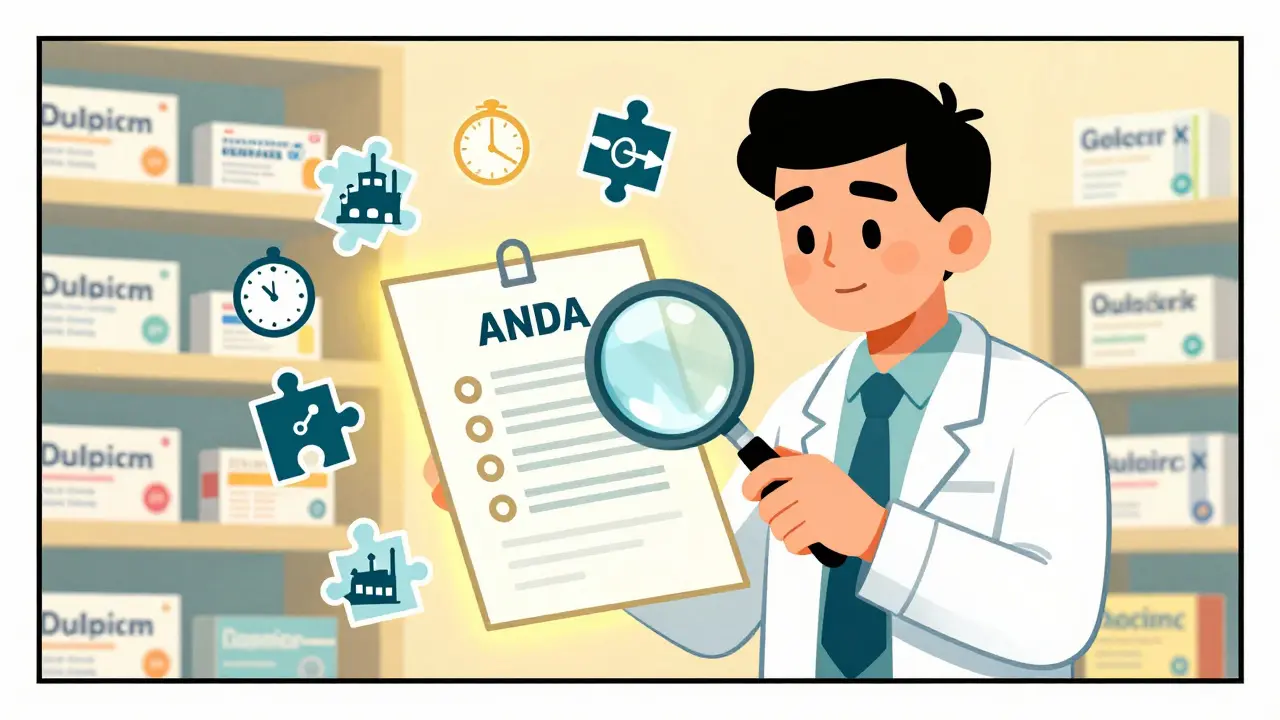
When you pick up a prescription at the pharmacy and see a generic version of your brand-name drug, you’re seeing the result of a highly regulated, science-driven process called the Abbreviated New Drug Application (ANDA). This isn’t just a shortcut-it’s a precise, legally defined pathway that lets safe, effective, and affordable generic drugs reach millions of Americans. The FDA doesn’t approve generics lightly. Every one of them must meet the same strict standards as the brand-name drug, even though they cost a fraction of the price.
What Exactly Is an ANDA?
The ANDA is the formal request submitted to the FDA to get a generic drug approved. It’s called "abbreviated" because it doesn’t require the same expensive, multi-year clinical trials that brand-name drugs go through. Instead, it builds on the safety and effectiveness data already proven by the original drug, known as the Reference Listed Drug (RLD). The goal? Prove that your generic version is identical in how it works inside the body-no more, no less.Under the Hatch-Waxman Act of 1984, the FDA created this system to balance two things: protecting innovation for new drugs and making sure patients can access cheaper versions once patents expire. Today, 90% of all prescriptions in the U.S. are filled with generics. That’s not luck-it’s the result of a well-oiled, though complex, approval machine.
Step 1: Identify the Reference Listed Drug (RLD)
Before you even start writing an ANDA, you need to pick the right brand-name drug to copy. This is your RLD-the official benchmark. You can’t just pick any similar drug; it has to be one that’s already been approved by the FDA and listed in the Orange Book, which tracks approved drug products and their therapeutic equivalence ratings.You’ll need to match your generic exactly: same active ingredient, same strength, same dosage form (tablet, capsule, injection), and same route of administration (oral, topical, IV). If your drug is a 500mg metformin tablet taken by mouth, your RLD has to be the exact same thing. No variations allowed. Even small differences can trigger a Complete Response Letter (CRL) from the FDA.
Step 2: Confirm Patent and Exclusivity Status
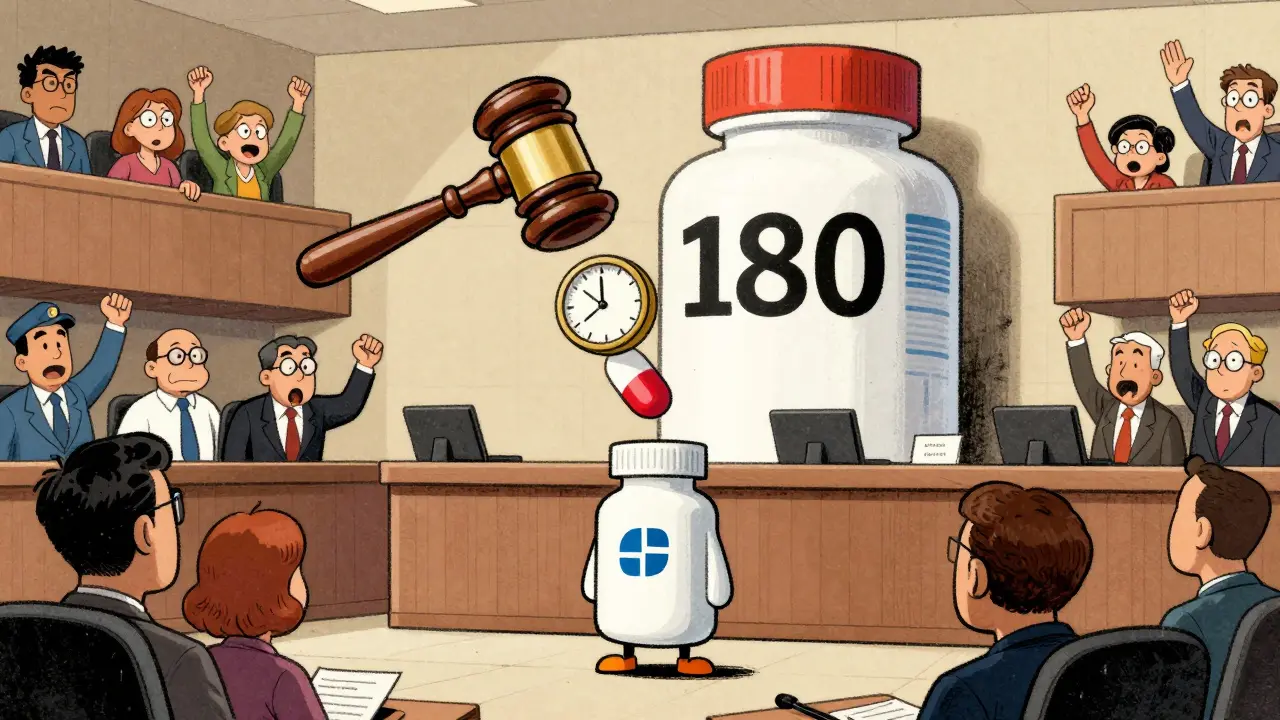
You can’t file an ANDA until the brand-name drug’s patents have expired-or you’re ready to challenge them. The FDA’s Orange Book lists every patent protecting the brand-name drug, including method-of-use patents and formulation patents. If any are still active, you have two choices: wait until they expire, or file a Paragraph IV certification.A Paragraph IV certification means you’re saying, "We believe this patent is invalid or won’t be infringed." This is where things get legal-and expensive. The brand-name company has 45 days to sue you. If they do, the FDA can’t approve your drug for 30 months unless the court rules in your favor. But if you’re the first to file and win, you get 180 days of exclusive marketing rights. That’s why companies like Teva and Mylan invest millions in legal teams just to be first in line.
Step 3: Develop the Generic Drug and Run Bioequivalence Studies
This is where science meets real-world testing. You have to prove your generic behaves the same way in the body as the RLD. That means running bioequivalence studies-typically with 24 to 36 healthy volunteers.Here’s how it works: volunteers take your generic version and the brand-name drug on separate occasions, usually in a crossover design. Blood samples are taken over time to measure how much of the drug enters the bloodstream and how fast. The FDA requires that your drug’s absorption rate and total exposure fall within 80% to 125% of the RLD’s values. That’s the bioequivalence window.
It’s not just about the active ingredient. You also have to prove your inactive ingredients (fillers, dyes, coatings) are safe and don’t interfere with how the drug works. Even something as simple as changing the coating on a tablet can affect how quickly it dissolves in the stomach. The FDA has rejected ANDAs over this kind of detail.
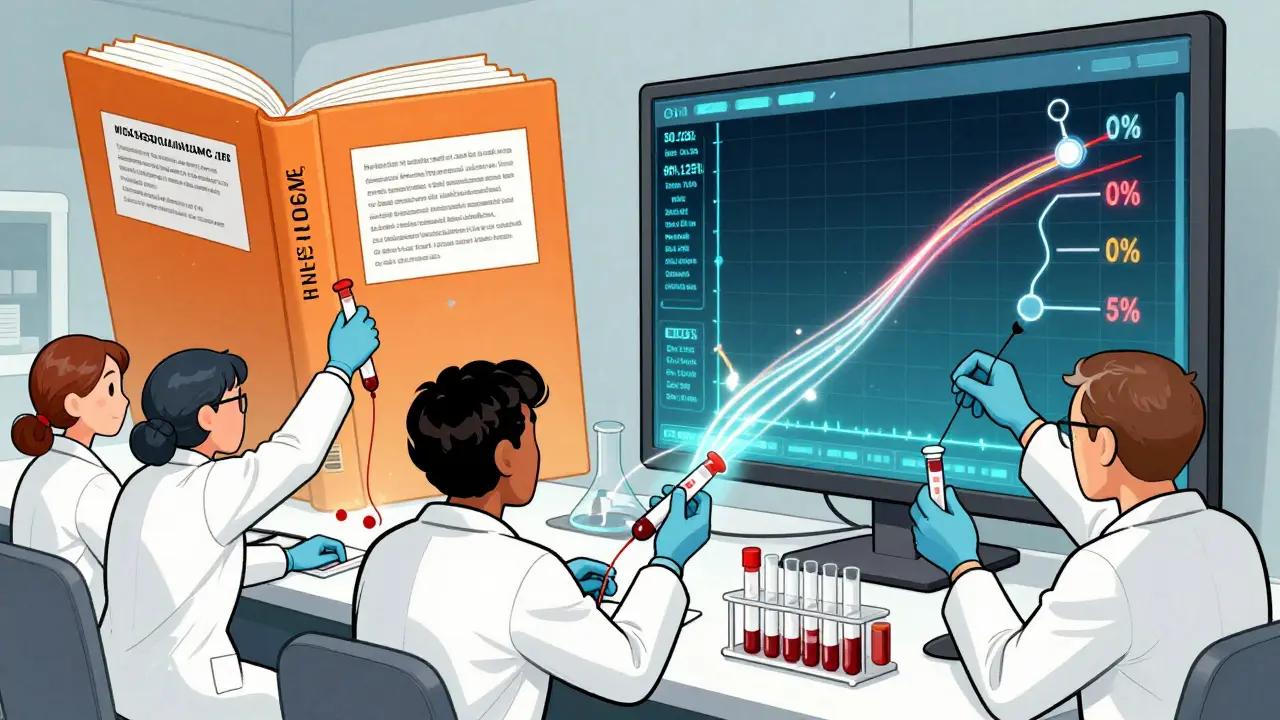
Step 4: Build the Chemistry, Manufacturing, and Controls (CMC) Package
This is the backbone of your ANDA. The CMC section proves you can make the same drug, batch after batch, under the same strict conditions as the brand-name maker. It includes:- Exact formulas for active and inactive ingredients
- Details on manufacturing equipment and processes
- Specifications for raw materials and finished products
- Stability data showing the drug won’t degrade over time
- Validation of analytical methods used to test the drug
Every step must follow Current Good Manufacturing Practices (cGMP). The FDA inspects your manufacturing sites-often without warning. If your facility doesn’t meet the same standards as the brand-name maker’s, your application gets rejected. In 2023, 22% of ANDA deficiencies were linked to manufacturing issues.
Step 5: Prepare the Labeling and Submit the ANDA in eCTD Format
Your generic’s label must match the RLD’s exactly-down to the font size and warnings. You can’t change the wording unless you’re correcting a safety issue already approved by the FDA. Even minor differences, like omitting a footnote about storage conditions, can delay approval.All ANDAs must be submitted electronically in the eCTD format. This isn’t just a PDF. It’s a structured digital dossier with five modules:
- Module 1: Administrative and region-specific info
- Module 2: Summaries of quality, nonclinical, and clinical data
- Module 3: Detailed chemistry, manufacturing, and controls
- Module 4: Nonclinical study reports
- Module 5: Clinical study reports (bioequivalence data)
Missing one file? Wrong folder name? The FDA will send you a filing deficiency letter within 60 days. You won’t even get to the review stage until your submission is technically complete.
Step 6: FDA Review and Inspection
Once your ANDA is filed, the clock starts. Under GDUFA IV (2023-2027), the FDA aims to review 90% of complete ANDAs within 10 months. But that’s only if your application is flawless.The review team includes chemists, pharmacologists, microbiologists, and statisticians. They check every page. They look for inconsistencies in data, gaps in protocols, and red flags in manufacturing. About 75% of ANDAs get approved on the first try. The other 25% get a Complete Response Letter (CRL).
A CRL isn’t a rejection-it’s a request for more info. Common reasons:
- Incomplete bioequivalence data (28% of CRLs)
- CMC issues like unclear manufacturing controls (32% of CRLs)
- Labeling mismatches (18%)
- Facility inspection failures
And don’t forget: the FDA will inspect your manufacturing site. That inspection can happen before, during, or after review. If they find problems-like poor sanitation, unvalidated equipment, or falsified records-you’re done. No second chances.
Step 7: Approval and Market Entry
If you pass, the FDA sends an approval letter. You’re now legally allowed to sell your generic. But you’re not done yet. You still need to get your product listed in the Orange Book, set up distribution, and convince pharmacies and insurers to switch from the brand.For the first generic to enter the market after patent expiration, you get 180 days of exclusivity. During that time, no other generic can compete. That’s why companies rush to file. The first generic version of Humira brought in over $1.2 billion in sales during its exclusivity window in 2023.
Why Some Generics Take Longer Than Others
Not all ANDAs are created equal. Simple pills? Those usually move fast. Complex products? That’s where things get messy.Inhalers, injectables, topical creams, and nasal sprays are considered complex drug products. Their performance depends not just on chemistry, but on how they’re delivered. A nasal spray might need the exact same particle size, spray pattern, and delivery device as the brand. The FDA has been working on new guidance for 27 types of complex products, and review times for these can stretch to 28 months or more.
One Reddit user from a generic drug company shared that their nasal spray ANDA got three CRLs over two years. Each time, they had to run new bioequivalence tests. The cost? Over $2.3 million. That’s not unusual for complex generics.
Who’s Winning the Generic Game?
The U.S. generic market is crowded but dominated by a few big players. Teva leads with 15.2% of the market, followed by Viatris (formerly Mylan) at 12.7%, and Sandoz at 10.3%. But there are over 100 companies competing, from multinational giants to small startups.The real winners? Patients. Generics save the U.S. healthcare system about $373 billion a year. They’re responsible for 90% of prescriptions-but only 23% of drug spending. That’s the power of competition.
What’s Changing in 2026?
The FDA is pushing hard to speed things up. GDUFA IV’s new goal: 8-month median review time for first-cycle approvals. They’re also testing AI tools to sort through documents faster-cutting down administrative delays by 25% by 2025.And while generics dominate small-molecule drugs, biosimilars (generic versions of biologics like Humira or Enbrel) are the next frontier. The FDA expects to approve 10 to 15 biosimilars a year by 2026, up from just 5 to 7 in 2023. The approval pathway is different, but the goal is the same: lower costs, same results.
Final Thoughts: Is the System Working?
Yes. The ANDA process has delivered safe, affordable drugs to tens of millions of Americans for over 40 years. It’s not perfect. There are delays. There are setbacks. But the data doesn’t lie: generics work. They save lives. They save money.For every company that struggles with a CRL, there’s another that gets approved in 9 months. For every facility that fails inspection, there are ten more that pass with flying colors. The system is designed to be rigorous-not easy. And that’s exactly how it should be.
How long does it take to get a generic drug approved by the FDA?
The FDA aims to review a complete ANDA within 10 months under GDUFA IV, with a goal of 8 months for first-cycle approvals. But the total timeline from start to finish-including developing the drug, running bioequivalence studies, and preparing the submission-is typically 3 to 4 years. Complex products like inhalers or injectables can take longer, sometimes over 4 years.
Do generic drugs work the same as brand-name drugs?
Yes. By law, generics must be pharmaceutically and bioequivalent to the brand-name drug. That means they deliver the same active ingredient, in the same amount, at the same rate into the bloodstream. The FDA requires bioequivalence studies to prove this. Over 90% of generics are therapeutically equivalent. Rare exceptions occur with narrow therapeutic index drugs, but these are closely monitored.
What happens if the FDA rejects my ANDA?
If your ANDA is rejected, you’ll receive a Complete Response Letter (CRL) listing the deficiencies. Common issues include flawed bioequivalence data, incomplete CMC documentation, or manufacturing problems. You can respond with additional data or studies. There’s no limit to how many times you can resubmit, but each delay costs time and money. About 25% of ANDAs receive a CRL on the first try.
Can I submit an ANDA before the brand-name patent expires?
Yes. You can file an ANDA anytime, even before the patent expires. But the FDA won’t approve it until the patent ends or you successfully challenge it with a Paragraph IV certification. If you’re the first to file and win a patent challenge, you get 180 days of market exclusivity-a major financial incentive.
Are generic drugs made in the same facilities as brand-name drugs?
Sometimes. Many brand-name companies also make generic versions of their own drugs. But most generics are made in separate facilities-often overseas. The FDA inspects all of them using the same cGMP standards. Whether made in the U.S., India, or China, every facility must pass inspection. The FDA has inspectors in over 100 countries.
All Comments
Sangeeta Isaac January 19, 2026
So I read this whole thing and honestly? I’m impressed. The FDA doesn’t cut corners, and that’s rare these days. Most people think generics are just cheap knockoffs, but the bioequivalence window? 80-125%? That’s not luck-that’s science with a backbone. I used to be skeptical until my mom’s blood pressure med switched and she didn’t even notice. No crashes, no weird side effects. Just cheaper, same results.
michelle Brownsea January 21, 2026
Let’s be clear: the fact that 90% of prescriptions are filled with generics is not a triumph of consumer choice-it’s a symptom of a broken, profit-driven healthcare system that prioritizes cost over care. The FDA’s process may be rigorous, but it’s also a band-aid on a bullet wound. We should be investing in public drug manufacturing-not outsourcing our pharmacopeia to labs in India and China while pretending it’s all ‘equivalent.’
And don’t get me started on the 180-day exclusivity loophole-this isn’t competition, it’s a corporate lottery where the same几家 conglomerates win every time.
Melanie Pearson January 23, 2026
China-made generics? No thanks. I don’t care if the FDA inspects them. If it’s not made in America, it’s not trustworthy. I’ve seen too many reports of contaminated fillers, substandard packaging, and delayed shipments. This isn’t just about efficacy-it’s about national security. We’re outsourcing our medicine supply chain to a country that doesn’t share our values. This is dangerous.
Alex Carletti Gouvea January 25, 2026
Same. I refuse to take anything made overseas. I don’t care if it’s ‘approved.’ If I can’t visit the factory myself, I’m not swallowing it. This whole system is a facade. The FDA’s got 100 inspectors for 1000+ facilities worldwide. They’re not checking- they’re rubber-stamping.
Jarrod Flesch January 27, 2026
Man, I’ve worked in a compounding pharmacy for 12 years. I’ve seen generics come in from India, Germany, even the U.S.-and honestly? The ones from India are often *better* made than some U.S. brand-name stuff. The FDA’s inspections are brutal. If a facility fails, it’s shut down. Period. I’ve seen inspectors pull samples from 3am batches just because the temp was 0.5°C off. It’s not perfect, but it’s way more rigorous than most people think.
Also, emojis? 👍 for the FDA. They’re the reason I can afford my insulin.
Barbara Mahone January 28, 2026
It’s fascinating how the system balances innovation and access. I’ve always thought of generics as ‘copycats,’ but reading this made me realize they’re more like translators-taking a complex, patented language and rendering it into something accessible without losing the meaning. The CMC section alone is a masterpiece of precision engineering. It’s not just chemistry-it’s art with regulations.
Uju Megafu January 29, 2026
Oh please. You think this is about safety? It’s about control. The FDA lets Big Pharma dictate which patents are ‘valid’ and which aren’t. And the 180-day exclusivity? That’s a cartel disguised as competition. Teva and Mylan don’t want generics-they want monopolies. And don’t even get me started on the fact that 60% of generic manufacturers are owned by the same companies that make the brand names. This isn’t a system-it’s a joke.
Stephen Rock January 30, 2026
Why are we even talking about this? The system works. It’s not perfect. It’s not meant to be. People take generics. They live. They don’t die. End of story. Stop overanalyzing. Just take your damn pill.
Kelly McRainey Moore January 31, 2026
I love that this exists. My dad’s on 7 meds-all generics. He used to skip doses because he couldn’t afford the brand names. Now he’s stable, happy, and saving $200 a month. That’s not just policy-that’s dignity. Thanks for explaining how it actually works. I finally get it.
Dee Monroe February 1, 2026
There’s something quietly beautiful about the ANDA process-it’s a quiet rebellion against the myth that innovation must be expensive. It says: knowledge belongs to everyone. The science doesn’t care if it’s branded or generic. The body doesn’t know the difference. What matters is that someone, somewhere, cared enough to replicate it with precision, not profit. That’s not just regulation-that’s ethics made tangible. Every time a patient picks up a cheaper pill, they’re holding a piece of that quiet revolution. And yet, we still treat generics like second-class medicine. We don’t need more patents-we need more humility.
Philip Williams February 1, 2026
Excellent breakdown. One thing I’d add: the real bottleneck isn’t the FDA-it’s the manufacturers. Too many companies treat ANDA submission like a checklist, not a commitment. The CRLs aren’t failures of oversight-they’re failures of preparation. If you’re going to enter this space, you need to treat it like a clinical trial, not a cost-cutting exercise. The science is sound. The people? Sometimes not so much.