
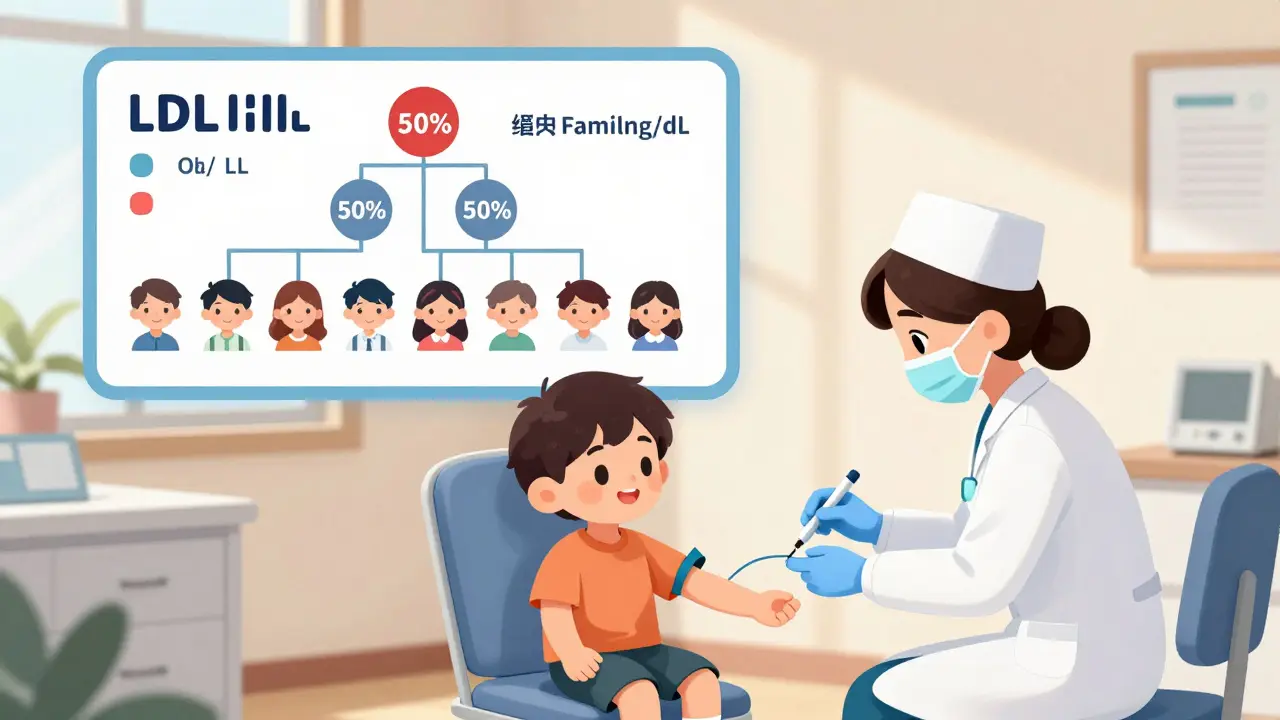
Familial hypercholesterolemia isn’t just high cholesterol. It’s a genetic time bomb. People born with this condition have LDL cholesterol levels so high from birth that their arteries start clogging decades before most people even think about heart health. Left untreated, a 30-year-old with FH can have the same risk of a heart attack as a 60-year-old with normal cholesterol. And here’s the scary part: 90% of people with FH don’t even know they have it.
What Is Familial Hypercholesterolemia?
Familial hypercholesterolemia (FH) is an inherited disorder that keeps your body from removing LDL cholesterol - the bad kind - from your blood. It’s passed down from just one parent, meaning if one of your parents has it, you have a 50% chance of inheriting it. This isn’t about eating too many burgers or skipping the gym. Even if you’re thin, fit, and eat clean, FH will still wreck your arteries if you don’t get treated.
The genetic flaw usually hits one of three spots: the LDL receptor, the PCSK9 gene, or the ApoB protein. These are the body’s main tools for cleaning LDL out of the bloodstream. When they’re broken, cholesterol piles up - often above 190 mg/dL in adults and 160 mg/dL in kids. In the rare homozygous form, where both parents pass on the gene, levels can hit 400 mg/dL or higher. That’s not just high. That’s emergency territory.
Why Most People Never Know They Have It
Unlike other heart risks - smoking, obesity, diabetes - FH often has no symptoms until it’s too late. No chest pain. No dizziness. Just silent, slow clogging of arteries. Many people don’t realize anything’s wrong until they have a heart attack in their 30s or 40s. That’s why it’s called a silent killer.
Physical signs like yellowish bumps on the knuckles or Achilles tendons (xanthomas) or a gray ring around the cornea (corneal arcus) can show up, but only in about 1 in 3 adults with the heterozygous form. Kids? Almost never. So if you’re waiting for visible signs, you’re already too late.
In the U.S., only 6-10% of people with FH are diagnosed. That means over 1.3 million Americans have it and don’t know it. Meanwhile, in the Netherlands - where they started systematic screening in the 1990s - over 18,000 cases have been found. The difference? They didn’t wait for symptoms. They tested families.
How to Get Diagnosed: The Two Best Methods
There are two proven ways to catch FH early: universal screening and cascade screening.
Universal screening means checking every child’s cholesterol between ages 9 and 11. The American Academy of Pediatrics and the American Heart Association both recommend this. It’s simple: a blood test. No fasting needed. If LDL is above 160 mg/dL, that’s a red flag. It doesn’t mean they definitely have FH - but it means they need further testing. This catches kids who inherited it from one parent, even if no one in the family has had a heart attack yet.
Cascade screening is what happens after someone is diagnosed. Once you know you have FH, you test your parents, siblings, and kids. Because it’s autosomal dominant, each first-degree relative has a 50% chance of having it. If a parent has FH, their children need testing. If a sibling has it, you need testing. This isn’t optional - it’s lifesaving. In countries like the UK and Norway, this approach has identified thousands of previously unknown cases.
Genetic testing is the gold standard. Finding the exact mutation confirms the diagnosis and makes cascade screening faster and cheaper. But even without genetic testing, you can still screen using LDL levels and family history. Tools like the Dutch Lipid Clinic Network (DLCN) criteria use cholesterol numbers, physical signs, and family heart disease history to give you a score. A score of 6 or higher? Very likely FH.

Why Waiting Is Deadly
Untreated heterozygous FH cuts life expectancy by 20-30 years. Men have a 50% chance of a heart attack before 50. Women, before 60. Homozygous FH? Most don’t live past 20 without aggressive treatment.
Here’s what happens when you delay: LDL cholesterol builds up in artery walls. It triggers inflammation. Plaques form. They rupture. Blood clots form. Heart attack. Stroke. Sudden death. And it doesn’t just affect one person. One undiagnosed parent can pass the gene to two kids, who pass it to four grandchildren - and so on. The ripple effect is massive.
Studies from South Africa and the Netherlands show that people with FH who start treatment before age 10 can live just as long as people without FH. That’s not a guess. That’s data. Early treatment doesn’t just delay heart disease - it prevents it.
Aggressive Treatment: What Actually Works
Treatment isn’t about diet and exercise alone. It’s about medication - early, strong, and consistent.
Statins are the first line. High-intensity statins like rosuvastatin or atorvastatin can lower LDL by 50% or more. For kids as young as 8-10, statins are safe and effective. The American Heart Association says treatment should start by age 8-10 if LDL is above 190 mg/dL, or earlier if there’s a strong family history.
But many people need more. That’s where ezetimibe comes in - a pill that blocks cholesterol absorption in the gut. It’s often added to statins. Then there’s PCSK9 inhibitors - injectables like evolocumab or alirocumab. These can slash LDL by another 60%. And now there’s inclisiran, a twice-yearly shot that works differently: it silences the PCSK9 gene at the RNA level. Fewer injections. Better adherence.
The goal? Get LDL below 100 mg/dL for adults, below 135 mg/dL for kids. And reduce LDL by at least 50% from baseline. Most people with FH need a combo of two or three drugs to hit that target.
It’s not about perfection. It’s about persistence. One study showed that people who stayed on statins for 10 years reduced their heart attack risk by 76%. That’s not a small win. That’s a life saved.
The Real Barrier: Why This Isn’t Happening
We have the tools. We have the science. We have the guidelines. So why is FH still underdiagnosed?
First, most doctors don’t think about it. Only 12% of U.S. pediatricians routinely screen kids for cholesterol, even though the guidelines say they should. Primary care doctors often dismiss high cholesterol in young people as “just genetics” or “it’ll fix itself.” It won’t.
Second, access. There’s one lipid specialist for every 1.5 million people in the U.S. Most people with FH never see one. They get a statin prescription and are told to “come back in six months.” But FH needs ongoing management - not just pills.
Third, insurance. Genetic testing can cost $1,000-$2,000. Many insurers won’t cover it unless you’ve already had a heart attack. That’s backwards. We’re paying for ER visits and stents instead of prevention.
Fourth, stigma. Some families avoid testing because they fear discrimination. But federal law (GINA) protects against health insurance and employment discrimination based on genetic results. That’s not a rumor. It’s the law.
What You Can Do Right Now
If you’re an adult and your LDL is above 190 mg/dL - or if you’ve had a heart attack before 55 (men) or 60 (women) - get tested for FH. Ask for a lipid panel and a family history review.
If you have a parent, sibling, or child with early heart disease, high cholesterol, or an FH diagnosis - get your cholesterol checked. Don’t wait. Don’t assume it’s not you.
If you’re a parent - ask your child’s pediatrician to check their cholesterol at age 9 or 10. If they say no, ask again. Or go to a lab directly. Many states allow direct access to cholesterol testing without a doctor’s note.
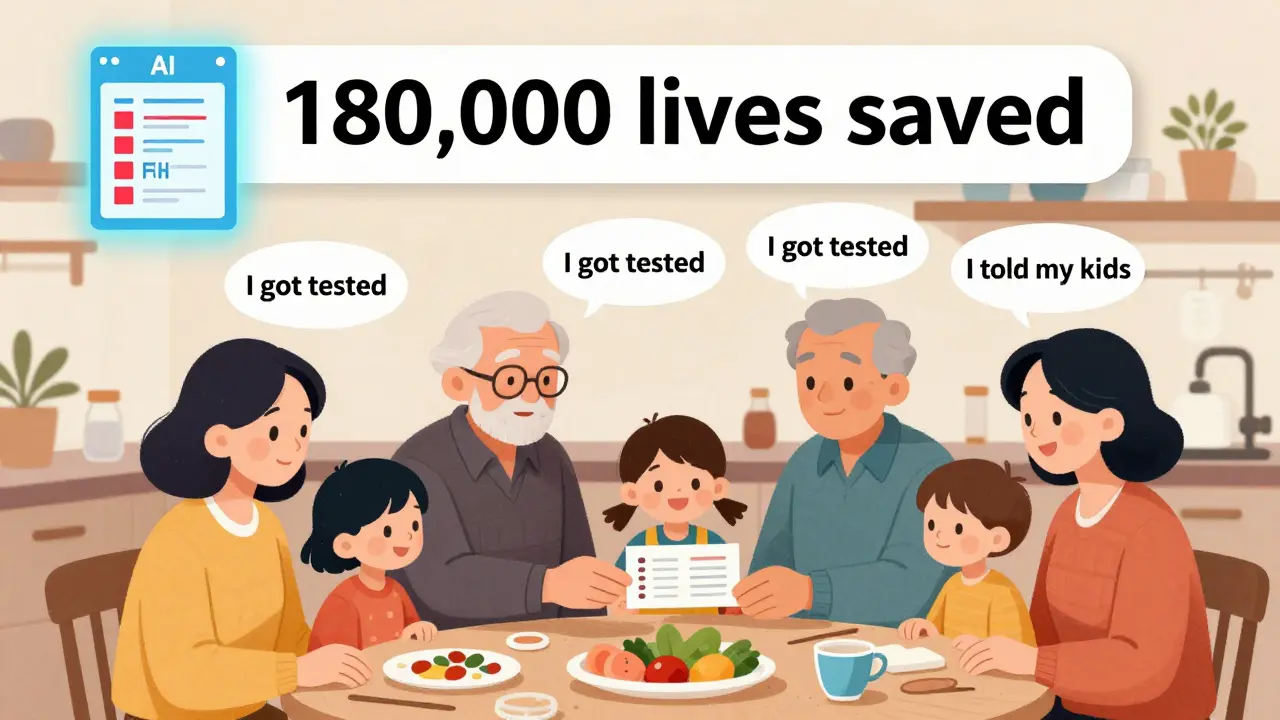
If you’ve been diagnosed with FH - tell your family. Send them the test results. Don’t wait. Don’t sugarcoat it. You’re not just protecting yourself. You’re protecting your kids, your siblings, your nieces and nephews.
The Future Is Here
Machine learning is now being used to scan electronic health records for patterns: high LDL, family history of early heart disease, tendon xanthomas. One 2023 study showed AI could spot FH cases with 92% accuracy - and it found people doctors missed.
Some clinics in the U.S. are starting FH registries, like the ones in the Netherlands. These track patients, remind doctors to screen families, and help researchers improve care. The FH Foundation has launched pilot programs in 12 states. They’re not perfect - but they’re working.
Every year, 250,000 Americans are projected to die prematurely from undiagnosed FH. But if we just did what we already know works - universal screening at age 10, cascade testing for families, aggressive lipid-lowering - we could prevent 180,000 of those deaths.
This isn’t science fiction. It’s medicine. And it’s waiting for someone to act.
All Comments
Nancy Kou December 20, 2025
FH is one of those silent killers that slips through the cracks because everyone assumes high cholesterol is just a diet problem. I had a cousin diagnosed at 28 after a minor heart scare. Turns out his dad had a heart attack at 37 and no one connected the dots. This isn’t rare. It’s epidemic.
Takeysha Turnquest December 20, 2025
So we’re supposed to believe that genetics can be outsmarted by pills and screenings when the entire system is built on profit not prevention
Dorine Anthony December 20, 2025
My pediatrician skipped the cholesterol test for my 10-year-old because he said it wasn’t ‘necessary’ unless there was a family history. I had to go to a lab myself. Took 15 minutes. Cost $40. They found his LDL at 210. Now he’s on a low-dose statin. No one else in the family knew they were at risk until now.
Hussien SLeiman December 21, 2025
Look, I get the urgency, but let’s not pretend this is some revolutionary breakthrough. We’ve known about FH since the 50s. The problem isn’t lack of knowledge-it’s systemic laziness. Doctors don’t want to deal with it. Insurance won’t pay for genetic tests until someone’s already in the ER. And parents? They’d rather believe their kid is fine because they don’t eat fast food. Meanwhile, arteries are turning to concrete. This isn’t about medicine. It’s about accountability. Someone’s got to start asking the hard questions before the next generation hits their 30s with a blocked artery and a $200k hospital bill.
Jedidiah Massey December 22, 2025
The PCSK9 inhibitor data is compelling, but the cost-benefit analysis remains questionable. At $14,000 annually per patient, even with 60% LDL reduction, the marginal utility diminishes significantly in populations with suboptimal adherence. Furthermore, the pharmacoeconomic models from the Netherlands assume universal access to lipid clinics-which is not scalable in a fragmented U.S. healthcare paradigm. We’re optimizing for biomarkers, not outcomes.
Allison Pannabekcer December 24, 2025
I’m a nurse who works in cardiology, and I’ve seen too many young people come in with LDL over 250 and zero symptoms. One 17-year-old girl came in after her brother had a heart attack. Turned out their mom had FH and never got tested. She’s on three meds now. Her mom finally got screened after seeing her daughter’s results. It’s not magic. It’s just… paying attention. If you have high cholesterol before 30, don’t shrug it off. Ask for a family history review. It could save your kid’s life.
Nicole Rutherford December 26, 2025
Everyone’s acting like this is a medical mystery when it’s really just poor parenting. If your kid’s LDL is sky high, maybe you should’ve gotten tested before having them. Or maybe you should’ve taken your own diagnosis seriously instead of pretending it was just ‘bad luck.’ Now we’re giving kids statins because adults refused to face reality. It’s not a public health crisis. It’s a failure of personal responsibility.
Emily P December 28, 2025
Does anyone know if there’s data on how many people with FH have children who never get tested because the family never talks about it? I feel like that’s the real hidden barrier-not insurance or doctors, but silence.
Nina Stacey December 28, 2025
My mom had a heart attack at 41 and no one knew why until years later when my brother got tested and found out we all have FH. I’m 34 now and on statins ezetimibe and inclisiran. I tell everyone I know to get tested. I don’t care if they think I’m being dramatic. I’d rather be annoying than bury my kids because no one talked about it
Kevin Motta Top December 29, 2025
My brother in Nigeria got diagnosed after a stroke at 32. He had no idea his dad had died young from heart issues. Now his kids are being screened. This isn’t a Western problem. It’s a human one. Culture, access, stigma-it all matters. But the science doesn’t care where you live. If your LDL’s over 190, you’re at risk. Period.
Dominic Suyo December 31, 2025
Let’s be real. The medical-industrial complex loves FH. It’s the perfect storm: lifelong meds, expensive injectables, genetic testing fees, specialist referrals. They’ll sell you a $10,000 drug to fix a problem they refused to screen for in the first place. The real solution? Stop waiting for symptoms. Start testing kids. But that wouldn’t make enough profit for the labs and pharma CEOs, would it?
James Stearns January 1, 2026
It is imperative to underscore that the current standard of care for familial hypercholesterolemia remains insufficiently standardized across clinical jurisdictions. The absence of uniform diagnostic protocols and the heterogeneity of lipid panel interpretation render population-level interventions inherently flawed. A national registry, standardized by federal mandate, is not merely advisable-it is non-negotiable.
Vicki Belcher January 2, 2026
Just had my 10-year-old’s cholesterol checked. 205. We’re starting statins next week. I’m terrified but also so relieved we caught it. If you’re reading this and your kid’s never been tested-do it. Don’t wait. I used to think it was overkill. Now I know it’s the only thing standing between my child and a heart attack before college. 🙏