
Every year, more than 800,000 Americans have a heart attack or stroke. Many of these events happen to people who didn’t know they were at risk. That’s where the ASCVD risk calculator comes in. It’s not magic. It’s math. But that math can save your life.
What Is the ASCVD Risk Calculator?
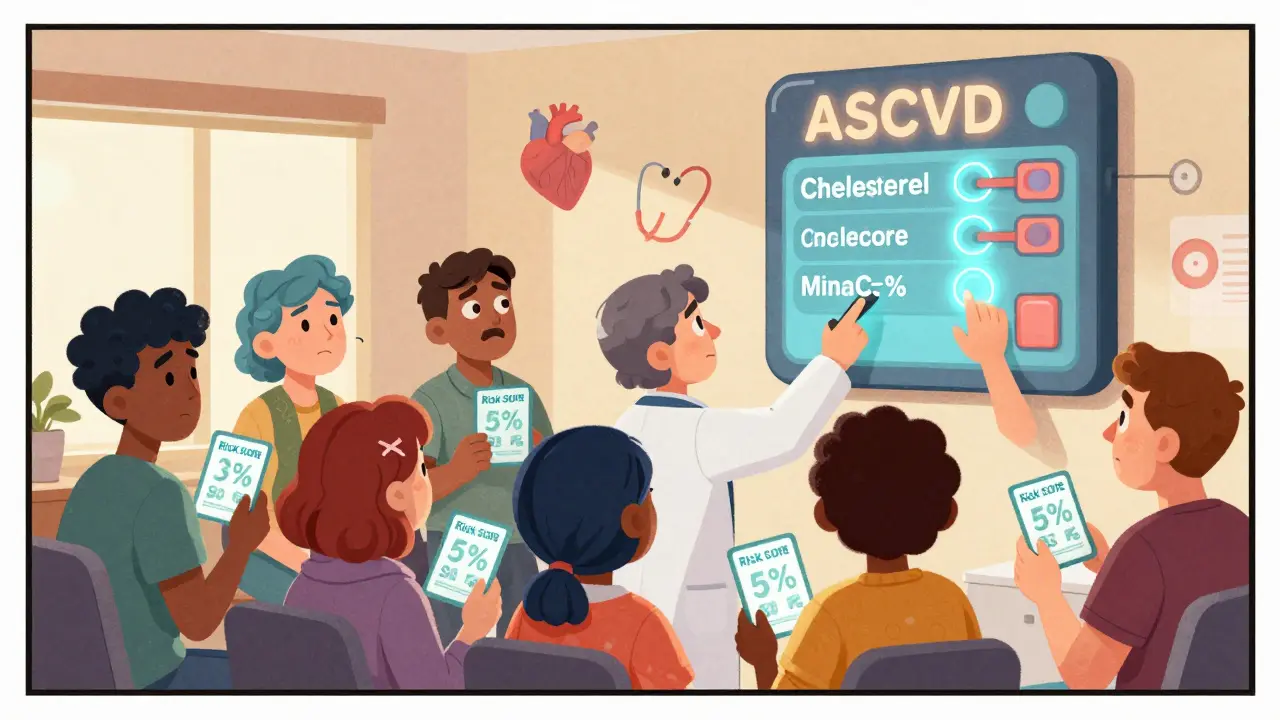
The ASCVD Risk Calculator is a tool doctors use to estimate your chance of having a heart attack or stroke in the next 10 years. It stands for Atherosclerotic Cardiovascular Disease - the kind caused by fatty plaques building up in your arteries. The calculator doesn’t guess. It uses data from over 60 years of research, including studies like the Framingham Heart Study and the Atherosclerosis Risk in Communities Study. It’s backed by the American College of Cardiology and the American Heart Association.You don’t need to be a doctor to use it. But you do need to know a few things about yourself. The calculator asks for nine details: your age, sex, race, total cholesterol, HDL cholesterol, systolic blood pressure, whether you take blood pressure medicine, if you have diabetes, and if you smoke. Enter those numbers, and it gives you a percentage. That’s your 10-year risk.
How the Numbers Break Down
The results fall into four clear buckets:- Low risk: Under 5% - your chance of a heart event in the next decade is small.
- Borderline risk: 5% to 7.4% - you’re not in the clear, but you’re not in the danger zone either.
- Intermediate risk: 7.5% to 19.9% - this is where things get interesting. About 1 in 3 adults in their 40s to 70s land here. This is the group where decisions matter most.
- High risk: 20% or higher - you’re at serious risk. Treatment is strongly recommended.
If your score is 7.5% or higher and you’re between 40 and 75, doctors usually talk about starting a statin. At 20% or above, they often recommend a higher-dose statin. But here’s the catch: the calculator isn’t a prescription. It’s a conversation starter.
Why It’s Not Perfect - And Why That Matters
The ASCVD calculator was built using data from mostly White and Black populations. That’s a problem. Studies show it underestimates risk by 15% to 25% for American Indians, South Asian Americans, and Puerto Ricans. At the same time, it overestimates risk for East Asian Americans and Mexican Americans by up to 20%.Why does this happen? Because the original studies didn’t include enough people from those groups. The math doesn’t know your full story. If you’re a 52-year-old South Asian woman with no diabetes but a family history of early heart disease, the calculator might tell you you’re low risk - even if your real risk is much higher.
That’s why experts say: never rely on this number alone. Dr. Donald Lloyd-Jones, who helped design the tool, says it should be the beginning of a talk - not the end. Your doctor needs to know your full history: your diet, your stress levels, your family’s heart health, even your neighborhood’s access to healthy food.
What Happens When the Score Is in the Middle?
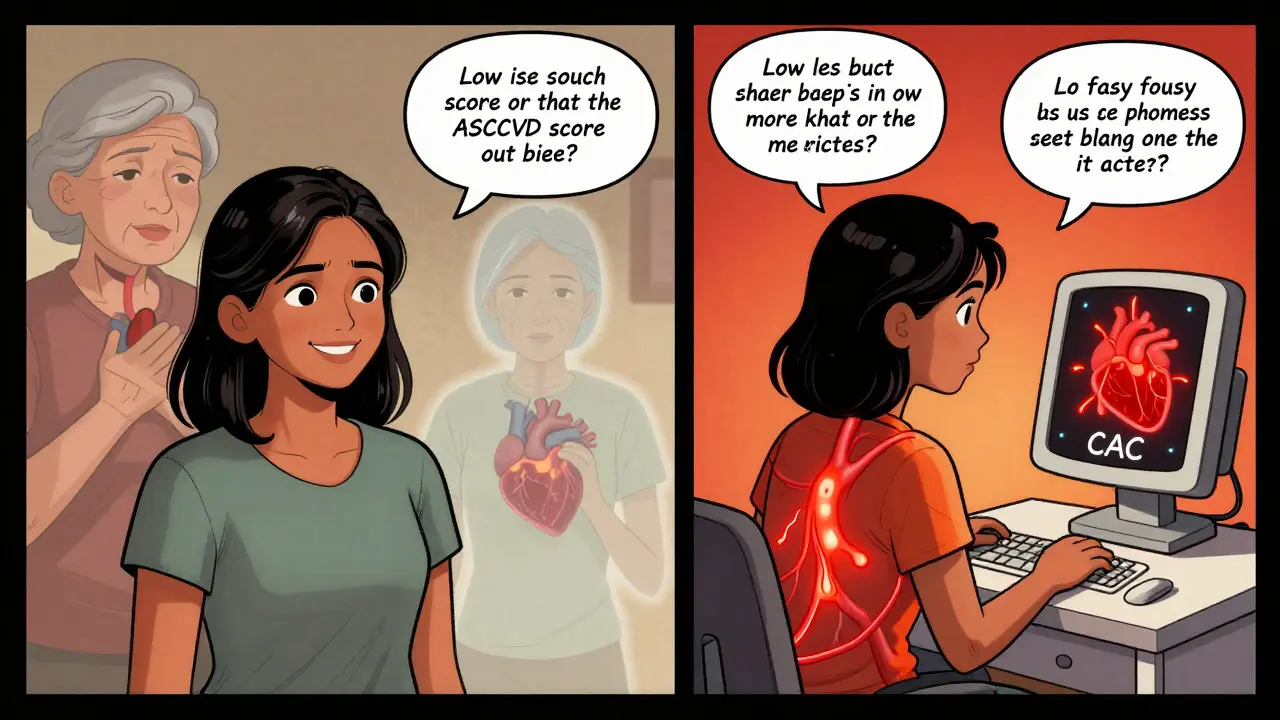
If you’re in the intermediate-risk zone - and most people are - the calculator alone won’t tell you what to do. That’s where doctors turn to extra tests.One of the most powerful tools is a coronary artery calcium (CAC) scan. It’s a simple CT scan that shows how much calcium is stuck in your heart arteries. No dye. No needles. Just a few seconds in the machine.
Here’s the kicker: if your ASCVD score says you’re intermediate risk, a CAC scan changes the game in over half the cases. If your CAC score is zero, your risk is likely lower than the calculator says. You might not need a statin. If your CAC score is high, your risk is worse than it looks - and you probably need treatment.
Other tests like high-sensitivity CRP (a marker of inflammation) or ankle-brachial index (to check for blocked leg arteries) can also help. But CAC is the gold standard for refining risk when the calculator leaves you unsure.
What About Lifetime Risk?
The calculator also gives you a lifetime risk number. This matters a lot if you’re under 55. Many people under 55 have a low 10-year risk - say, 6% - but a lifetime risk of 50% or higher. That means even if you won’t have a heart attack in the next decade, you’re still on a dangerous path.For younger people, lifestyle changes are the most powerful tool. Quitting smoking, eating more vegetables, walking 30 minutes a day, and losing even 5% of your body weight can cut your lifetime risk by half. The ASCVD calculator helps you see that the clock is ticking - even if it’s not ticking fast yet.

How This Tool Changed Heart Care
Before the ASCVD calculator, doctors often treated people based on cholesterol numbers alone. If your LDL was over 160, you got a statin. If it was under, you didn’t. That didn’t work. Many people with normal cholesterol still had heart attacks. Others with high cholesterol never did.The ASCVD calculator changed that. It looks at the whole picture: cholesterol, blood pressure, smoking, diabetes, age, race. Since it became standard in 2014, statin use has gone up 27% in people who truly need it. But here’s the dark side: only 58% of high-risk patients actually get the treatment they’re supposed to. Too many people still fall through the cracks.
The Future of Risk Calculators
The next version of the ASCVD calculator is already being tested. The American Heart Association launched PREVENT Online in January 2023 - and it’s different. It now includes social factors: how much money you make, whether you live in a food desert, if you have safe places to walk. These factors raise heart disease risk by 23% - and the old calculator didn’t see them at all.Researchers are also testing tools that add your DNA. A 2023 study showed that including genetic data improved risk prediction by 14%. Imagine a future where your doctor runs a simple blood test, pulls your cholesterol, your CAC score, your lifestyle, your zip code, and your genetic risk - and gives you a single, personalized plan.
But for now, the tool you have is good enough - if you use it right.
What to Do Next
If you’re between 40 and 75:- Ask your doctor for your ASCVD risk score. Don’t wait for them to bring it up.
- If you’re in the intermediate range, ask about a CAC scan. It’s quick, cheap, and often covered by insurance.
- Don’t ignore your lifetime risk - especially if you’re under 55.
- Focus on what you can control: quit smoking, move more, eat real food, sleep better.
- If your doctor says you don’t need a statin, ask why. If they say you do, ask what the goal is - and what happens if you wait.
Heart disease doesn’t strike suddenly. It builds quietly. The ASCVD calculator is your early warning system. Use it to start the conversation - not to end it.
What inputs does the ASCVD risk calculator require?
The calculator needs nine pieces of information: your age (between 40 and 79), sex, race (White, Black, Hispanic, or Asian), total cholesterol, HDL cholesterol, systolic blood pressure, whether you take blood pressure medication, if you have diabetes, and whether you currently smoke. All values must be accurate - misreporting smoking status or blood pressure can lead to incorrect risk estimates.
Is the ASCVD calculator accurate for all racial groups?
No. Studies show it underestimates risk by 15-25% for American Indians, South Asian Americans, and Puerto Ricans. It overestimates risk by 10-20% for East Asian Americans and Mexican Americans. This is because the original data came from limited populations. Experts recommend using additional tools like CAC scoring or ethnic-specific calculators (such as the SAFR score for South Asians) when available.
What should I do if my ASCVD score is intermediate?
If your 10-year risk is between 7.5% and 19.9%, your doctor should consider a coronary artery calcium (CAC) scan. This test finds calcium buildup in your heart arteries and can reclassify your risk in over half of intermediate-risk cases. A CAC score of zero often means you don’t need a statin. A high score means you likely do. Other tests like hsCRP or ABI may also help, but CAC is the most reliable next step.
Can I use the ASCVD calculator if I’m under 40 or over 79?
The official calculator is only validated for people aged 40 to 79. If you’re younger, your doctor should still assess your risk using family history, cholesterol levels, blood pressure, and lifestyle factors - but they’ll rely on lifetime risk estimates instead of the 10-year calculator. If you’re over 79, risk assessment still matters, but treatment decisions are based more on overall health, frailty, and personal goals than on a single number.
Does the ASCVD calculator replace seeing a doctor?
Absolutely not. The calculator is a tool to guide discussion - not make decisions. It doesn’t know your full story: your stress levels, sleep quality, mental health, diet patterns, or family history beyond what’s entered. Your doctor uses the number as a starting point, then combines it with your physical exam, lab results, and personal values to create a plan. Never use the score alone to start or stop medication.
All Comments
Madhav Malhotra January 11, 2026
As a South Asian guy, I’ve seen this play out firsthand. My dad’s ASCVD score said ‘low risk’-but he had a heart attack at 56. Turned out his family history and diet (lots of ghee and fried snacks) were red flags the calculator missed. We switched to the SAFR tool after that. If you’re from the subcontinent, don’t trust the default numbers. Talk to your doc. Seriously.
Christian Basel January 13, 2026
The ASCVD algorithm’s calibration bias is a well-documented systemic flaw rooted in the epidemiological homogeneity of the Framingham cohort. The lack of adequate representation in the training dataset introduces significant miscalibration for non-European and non-African American populations, thereby undermining its clinical utility as a population-level risk stratification instrument.
Roshan Joy January 14, 2026
Just ran my numbers-7.8%. Intermediate. 🤔 I asked my doc about the CAC scan and she said ‘sure, let’s do it.’ Got the results back: CAC = 0. She said ‘you’re golden, no statin needed.’ Mind blown. The calculator got it wrong, but the scan saved me from unnecessary meds. If you’re in the gray zone, push for the scan. It’s worth it. 💪❤️
Sean Feng January 15, 2026
Why are we still using this outdated tool when we have genetic testing and AI models now The calculator ignores stress sleep and mental health entirely It’s 2025 and we’re still relying on cholesterol and blood pressure numbers from the 90s
Adewumi Gbotemi January 15, 2026
My brother in Nigeria got a heart attack at 48. He never had high cholesterol. No diabetes. But he worked 12-hour shifts, ate fried plantains every day, and never slept. The calculator would’ve called him low risk. But his body was screaming. It’s not just numbers. It’s life.
Priya Patel January 17, 2026
OMG I just did the calculator and got 12% 😱 I thought I was fine because I run 3x a week and eat kale. Then I remembered I smoke 2 cigarettes a day and my dad had triple bypass at 50. YIKES. I’m quitting smoking this week. No excuses. Also-yes to CAC scan. I’m booking it. 🙌❤️
Alfred Schmidt January 19, 2026
Stop pretending this calculator is useful! It’s a corporate-approved gimmick designed to push statins! The AHA and ACC are in bed with Big Pharma! My neighbor’s CAC score was zero but they still gave him a 40mg statin because his ‘risk’ was 8%! This is medical gaslighting!
Priscilla Kraft January 19, 2026
Hi everyone-just wanted to add that if you're under 55 and your 10-year risk is low but your lifetime risk is high (like 50%+), don't wait. Start now. Swap soda for water. Walk after dinner. Sleep 7+ hours. These aren’t ‘lifestyle changes’-they’re life-saving habits. And yes, the CAC scan is worth every penny. I got mine at 42-CAC=120. Changed everything. You’re not too young to care. ❤️