
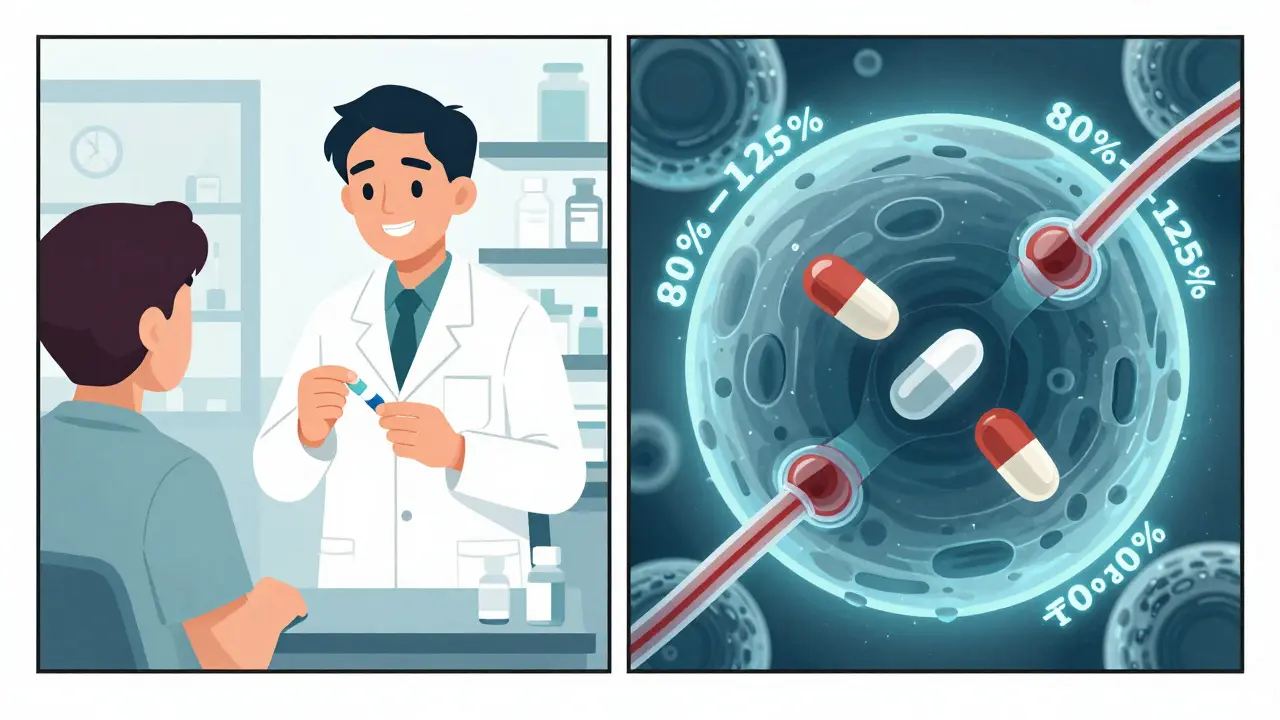
When you pick up a prescription at the pharmacy, you might not think twice about whether it’s the brand-name drug or the generic. But behind that simple choice lies a rigorous scientific process that keeps millions of patients safe every day: bioequivalence testing. This isn’t just paperwork or bureaucracy-it’s the invisible guardrail that ensures your generic medication works just as well as the brand-name version, without putting your health at risk.
What Bioequivalence Really Means
Bioequivalence isn’t about looking the same or costing the same. It’s about performance. Two drugs are considered bioequivalent if they deliver the same amount of active ingredient to your bloodstream at the same speed. That means your body absorbs the generic version the same way it would the brand-name drug. The science behind this is precise: regulators measure how much of the drug enters your blood (AUC) and how fast it peaks (Cmax). For most drugs, the generic must fall within 80% to 125% of the brand’s values. That’s not a wide margin-it’s a tight, scientifically validated range designed to eliminate any meaningful difference in effect.
This standard didn’t come from guesswork. It was forged in the 1984 Hatch-Waxman Act, which created the modern path for generic drugs in the U.S. Before that, companies could sell copies without proving they worked the same. Today, every generic must pass this test before it hits the shelf. The FDA and EMA both enforce this. And it’s not just a formality-studies involve real people, controlled conditions, and advanced blood testing. Typically, healthy volunteers take both the brand and generic versions in separate sessions, with blood drawn over hours to map out absorption curves. The data is then analyzed statistically to confirm equivalence.
Why This Matters for Your Health
Imagine you’ve been taking a blood thinner like warfarin for years. A tiny change in how much of the drug reaches your bloodstream could mean the difference between preventing a clot and causing dangerous bleeding. That’s why drugs with a narrow therapeutic index-where the effective dose is very close to the toxic dose-need extra scrutiny. For these, regulators sometimes tighten the bioequivalence window to 90-111%. The same goes for thyroid meds like levothyroxine. After the FDA updated its standards in 2012, manufacturers had to prove their generics matched the brand’s absorption profile within a much narrower range. The result? Fewer reports of under- or over-treatment.
But bioequivalence isn’t just about avoiding harm. It’s about ensuring consistent results. If a generic drug absorbed too slowly, your blood pressure might spike. If it absorbed too fast, you could get side effects like dizziness or nausea. These aren’t theoretical risks-they’ve been documented in rare cases before bioequivalence rules were strengthened. The testing stops those problems before they reach patients.
How Testing Protects Against Hidden Risks
Some drugs don’t just rely on the active ingredient. Take losartan, a blood pressure medication. Its real effect comes from a metabolite called EXP-3174, which forms in the liver. A generic that doesn’t produce the same level of this metabolite would fail, even if the parent drug levels looked fine. Bioequivalence studies now require measuring both. This level of detail is standard for drugs with active metabolites, complex delivery systems, or those taken with food.
Even more complex are topical creams, inhalers, and eye drops. You can’t just measure blood levels for these. The drug has to work where it’s applied-on your skin, lungs, or cornea. That’s why the FDA and EMA have developed special testing methods, including in-vitro dissolution tests and imaging techniques. In 2023, the EMA released new guidelines specifically for topical products, acknowledging how hard it is to prove equivalence when the drug doesn’t enter the bloodstream.
And then there’s the issue of variability. Some drugs naturally vary a lot from person to person. For these highly variable drugs (HVDs), regulators use a method called scaled average bioequivalence. Instead of a fixed 80-125% range, they adjust it based on how much the drug varies in the body-up to 75-133%-but only if the average difference between generic and brand is very small. This prevents a product that’s wildly different from slipping through.
What the Data Shows About Safety
People worry about generics. Reddit threads are full of stories: “I switched to generic sertraline and felt awful.” “My blood sugar went haywire after changing brands.” These anecdotes are real to the people who experience them. But they don’t tell the whole story.
The FDA tracks every adverse event reported through its FAERS database. From 2020 to 2023, only 0.07% of all drug-related adverse events involved generics that passed bioequivalence testing. Compare that to 2.3% for brand-name drugs. Why? Because brand drugs also have side effects-and sometimes more, because they’re used by more people with more complex conditions. The system works.
A 2022 survey by the National Community Pharmacists Association found that 87% of U.S. patients felt their generic drugs worked just as well as the brand. On Drugs.com, 58% of users who reviewed generic levothyroxine said it worked the same. These aren’t isolated opinions-they’re patterns backed by millions of real-world uses.
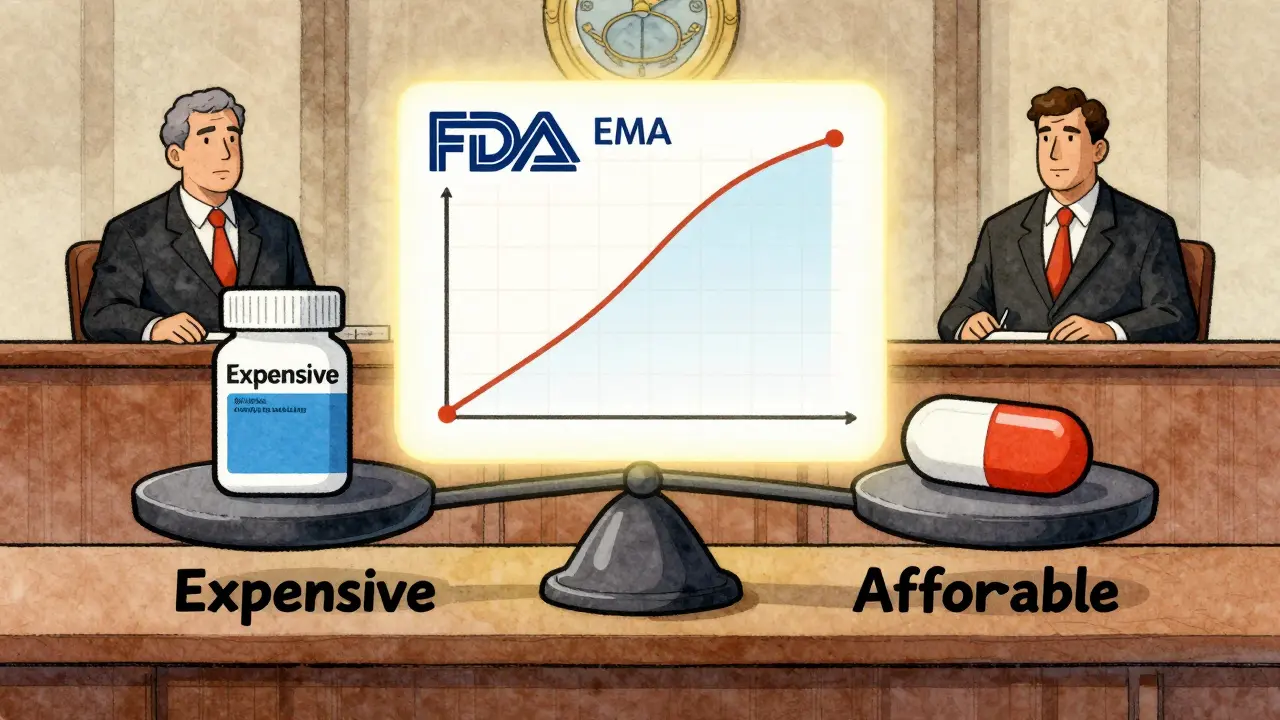
And cost matters. Generic drugs make up 90% of prescriptions in the U.S. but only 23% of total drug spending. In 2020 alone, they saved the system $313 billion. That’s not just money-it’s access. Without bioequivalence, many people couldn’t afford their meds at all.
What Happens When Testing Isn’t Done Right
Not every country has the same standards. Japan requires fasting studies even if the brand drug is meant to be taken with food. Brazil mandates a fixed set of medical tests regardless of the drug. These differences create headaches for manufacturers trying to sell globally. But they also create risks. A generic approved in one country might not meet the safety standards of another.
That’s why international groups like the International Pharmaceutical Regulators Programme (IPRP) are pushing for harmonization. More than 134 countries now require bioequivalence testing, up from 89 in 2015. But gaps remain. In places with weak oversight, substandard generics still appear. That’s why FDA and EMA approval remains the gold standard.
There’s also the rise of biosimilars-biologic drugs that aren’t chemically identical but are designed to mimic another. These require a whole different level of testing: structural analysis, immune response checks, and sometimes full clinical trials. Bioequivalence for small-molecule generics doesn’t apply here. But the principle is the same: prove safety and effectiveness before patients use it.
The Future of Bioequivalence
The field is evolving. In 2022, the FDA accepted 17 submissions using physiologically-based pharmacokinetic (PBPK) modeling-computer simulations that predict how a drug behaves in the body. This could one day reduce the need for human studies for some drugs. AI is also being tested to predict bioequivalence from dissolution profiles. The FDA’s 2023-2027 plan calls for using advanced characterization to cut down on clinical trials.
But experts agree: human testing isn’t going away anytime soon. For complex products like inhalers, ointments, and extended-release pills, nothing beats real-world data. Dr. Lawrence Yu, former FDA deputy director, called topical drug equivalence “one of the most difficult scientific challenges.” That’s why the FDA’s 2022 initiative focused on these products-because getting them right is critical.
And the demand is growing. IQVIA predicts 94% of U.S. prescriptions will be generic by 2027. That means more people relying on this system. More pressure to keep it strong. More need to understand why testing matters.
What You Can Do
If you’ve had a bad experience switching to a generic, talk to your pharmacist. Ask if the generic you’re taking is on the FDA’s list of approved products. Check the Orange Book. Ask if the manufacturer has passed bioequivalence testing. Most pharmacists can tell you the difference between a compliant generic and one that’s questionable.
Don’t assume all generics are equal. Some are made by companies with decades of experience. Others are newer players. The system works-but only if it’s enforced. And it’s enforced because of the data, the standards, and the thousands of studies done every year to prove one simple thing: your health shouldn’t depend on the price tag.
Are generic drugs really as safe as brand-name drugs?
Yes, when they’ve passed bioequivalence testing. The FDA requires generics to deliver the same amount of active ingredient at the same rate as the brand. Studies show that 90% of generic drugs in the U.S. meet this standard. Adverse event reports involving approved generics are extremely rare-only 0.07% of all reports from 2020-2023. This doesn’t mean side effects never happen, but they’re not caused by the generic being inferior-it’s usually individual variation or unrelated factors.
Why do some people say generics don’t work for them?
Sometimes, it’s because of psychological factors-people expect generics to be less effective. Other times, it’s because they switched between different generic manufacturers, each with slightly different inactive ingredients that affect absorption. For example, changing from one generic levothyroxine to another-even if both are FDA-approved-can cause fluctuations in thyroid levels. That’s why doctors often recommend sticking with the same generic brand. It’s not that the drugs are unsafe; it’s that consistency matters, especially for drugs with narrow therapeutic windows.
Does bioequivalence testing apply to all types of drugs?
No. Bioequivalence testing is for small-molecule drugs-chemicals with a fixed structure, like aspirin or metformin. It doesn’t apply to biologics like insulin or Humira, which are made from living cells. Those require a different process called biosimilarity testing. It’s more complex, involving structural analysis, immune response checks, and often clinical trials. Topical, inhaled, and injectable products also have special testing rules because they don’t enter the bloodstream the same way.
How long does bioequivalence testing take?
A typical bioequivalence study takes 12 to 18 months. This includes designing the trial, recruiting volunteers, conducting the tests, analyzing data, and submitting results to regulators. Each study costs between $1 million and $2 million. For complex drugs-like extended-release pills or topical creams-it can take longer and cost more. The process is slow because it has to be precise. One mistake in dosing, timing, or measurement can invalidate the whole study.
Can a generic drug be pulled from the market after approval?
Yes. If post-market data shows a pattern of adverse events or inconsistent performance, the FDA can investigate. In rare cases, they’ll require the manufacturer to conduct new bioequivalence studies. If the drug fails again, it’s removed. This has happened with a few generics over the past decade, mostly for drugs like levothyroxine or anticoagulants. The system isn’t perfect-but it’s designed to catch problems after they appear, not just before approval.
All Comments
Andrew Poulin March 5, 2026
Generic drugs work fine unless you're one of those people who swears their Zoloft stopped working after switching. Spoiler: it's not the drug, it's your brain playing tricks on you.
Tim Hnatko March 7, 2026
I've been a pharmacist for 22 years. I've seen patients panic over generic switchovers, only to realize they were reacting to the dye in the pill or the new filler. The science is solid. The fear? Not so much. Stick with one manufacturer if it works. Don't chase the cheapest one every time.
Also, if your thyroid med feels off? It's probably not the active ingredient. It's the lactose or cornstarch. Small changes, big effects in sensitive cases.
Bottom line: bioequivalence isn't magic. It's math. And math doesn't lie.
Weston Potgieter March 7, 2026
Let’s be real most generics are fine until you get one from some factory in Bangladesh that’s cutting corners. FDA approval doesn’t mean squat if the supply chain’s a joke. I’ve seen pills that crumble in your hand. No joke. And yeah the data says 0.07% but that’s only what gets reported. Most people just stop taking it and move on. No one’s tracking that.
Also why do we even need 80-125%? Why not 95-105? We’re talking life or death meds here. This isn’t a discount soda brand.
Vikas Verma March 8, 2026
From an Indian pharmaceutical perspective, bioequivalence testing is the backbone of global access to affordable medicine. Our industry has evolved from being perceived as low-quality to now supplying over 50% of US generic demand. The regulatory rigor is non-negotiable. We invest heavily in PK/PD modeling, dissolution profiling, and stability testing. Compliance isn’t optional-it’s survival.
Harmonization with FDA/EMA standards has lifted entire economies. Millions in developing nations rely on this framework. The science is mature. The challenge now is scaling quality uniformly across borders.
Sean Callahan March 8, 2026
so i switched to generic citalopram and felt like a zombie for 3 weeks?? like i wasnt even me anymore. my doc said 'its the same molecule' but nope. i went back to brand and felt like i had my soul back. so yeah maybe the math works but the human body? not always on the same page.
also why do they use different fillers? like why cant they just make it identical? its not like it costs extra to use the same cornstarch
also my pharmacist said some generics are made by the same company as the brand?? so why the difference??
Ferdinand Aton March 9, 2026
Wait so you’re telling me the FDA says 80-125% is fine but then for thyroid meds they tighten it to 90-111%? So which is it? Are they lying or just confused? Seems like they’re making it up as they go.
Also why is it that when you switch from one generic to another generic you get side effects? If they’re all bioequivalent… shouldn’t they be interchangeable? Sounds like a scam to me.
William Minks March 10, 2026
Love this breakdown 🙌
Just want to add-my grandma’s on levothyroxine and she’s been on the same generic for 8 years. No issues. But when the pharmacy switched her to a different one without telling her? She got shaky, tired, and started forgetting names. Took 6 weeks to stabilize. So yeah, consistency matters more than we think.
Pharmacist should always tell you when the generic changes. It’s not just about science-it’s about human rhythm.
Susan Purney Mark March 12, 2026
Thank you for writing this. As someone who’s had to switch generics three times due to insurance changes, I can say-yes, the science is solid. But the system? Not so much.
The real issue isn’t bioequivalence. It’s lack of transparency. No one tells you when your generic changes. No one warns you about filler differences. And if you feel weird? You’re told you’re ‘overreacting’.
So yes, the testing works. But the communication? Broken.
Please, pharmacists: if you switch my med, tell me. And if I react? Listen. Not every weird feeling is ‘in my head’.
Also, I’m glad someone finally mentioned active metabolites. That’s the part no one talks about. 🙏