
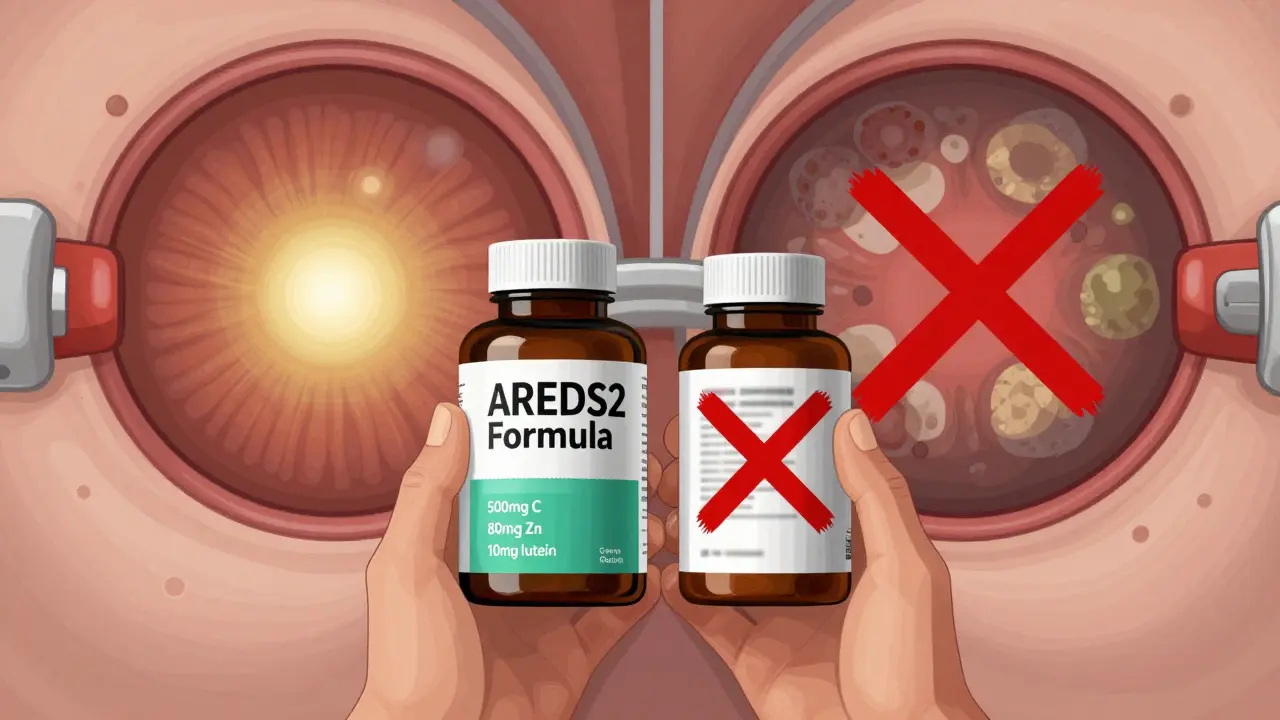
Not all eye supplements are created equal. If you’ve been told you have age-related macular degeneration (AMD), you might be wondering if those colorful pills in the aisle are right for you. The short answer: only if you have the right stage of the disease. The AREDS2 formula isn’t a magic pill for vision loss, nor is it meant for prevention. But for a specific group of people, it’s one of the few evidence-backed tools that can slow down vision decline.
What Is the AREDS2 Formula?
The AREDS2 formula isn’t just another antioxidant blend. It’s the result of a decade-long clinical trial led by the National Eye Institute (NEI), part of the NIH. Researchers didn’t guess at what might help-they tested real people over years, tracked their vision, and adjusted the formula based on hard data.
The original AREDS formula (from 2001) included high-dose vitamin C, vitamin E, zinc, copper, and beta carotene. It reduced the risk of AMD progression by about 25% in people with intermediate AMD. But beta carotene came with a hidden cost: it raised the risk of lung cancer in current and former smokers. That’s why the AREDS2 study, which ran from 2001 to 2012, replaced it.
The updated formula now contains:
- 500 mg vitamin C
- 400 IU vitamin E
- 10 mg lutein
- 2 mg zeaxanthin
- 80 mg zinc (as zinc oxide)
- 2 mg copper (as cupric oxide)
This specific mix is what’s been shown to work. Not every “eye health” supplement on the shelf has these exact numbers. Many contain far less lutein, or skip copper entirely-which can be dangerous if you’re taking high zinc doses long-term.
Who Should Take AREDS2 Vitamins?
This is where most people get it wrong. AREDS2 supplements are not for everyone with eye problems. They’re not for people with early AMD. They’re not for people with no AMD at all. And they definitely don’t reverse vision loss.
The only people who benefit are those with:
- Intermediate AMD in one or both eyes (defined by many medium-sized drusen or at least one large drusen), OR
- Advanced AMD (geographic atrophy) in one eye, with intermediate AMD in the other.
That’s it. If you have small drusen or no signs of AMD, taking these supplements won’t protect you. A 2023 analysis from Vision-and-Eye-Health.com made it clear: “The AREDS2 formula does not offer benefits for individuals with early AMD, nor does it prevent the onset of the condition.”
Why? Because AMD progression at the intermediate stage involves oxidative stress and inflammation in the macula. The AREDS2 nutrients target that specific biological pathway. In early AMD, those processes aren’t active enough for the supplement to make a difference. It’s like using a fire extinguisher on a candle-too early, too little effect.
Why Lutein and Zeaxanthin Beat Beta Carotene
Replacing beta carotene wasn’t just about safety-it was about better results.
A 10-year follow-up published in JAMA Ophthalmology in May 2022 tracked 3,882 participants from the original AREDS2 trial. Those who took lutein and zeaxanthin instead of beta carotene had a 26% lower risk of progressing to late-stage AMD. The hazard ratio was 0.88, meaning an 18% improvement over the old formula.
And here’s the kicker: people with low dietary intake of lutein and zeaxanthin saw the biggest benefit. If you don’t eat leafy greens, eggs, or corn regularly, your body likely isn’t getting enough of these pigments naturally. The supplement fills that gap.
Beta carotene, on the other hand, was linked to a 20% higher risk of lung cancer in former and current smokers. That’s why the American Academy of Ophthalmology now explicitly recommends the lutein/zeaxanthin version for everyone, regardless of smoking history.
What About Omega-3s? Did They Help?
Researchers added omega-3 fatty acids (DHA and EPA) to one version of the AREDS2 trial, hoping they’d boost protection. They didn’t.
The data showed no additional benefit from omega-3s in slowing AMD progression. That surprised many experts. It’s a reminder that not every popular nutrient has a proven role here. Just because fish oil is good for your heart doesn’t mean it helps your macula.
That’s why you should avoid “enhanced” AREDS2 formulas that include omega-3s, herbs, or extra antioxidants. Stick to the exact NEI-recommended mix. More isn’t better-it’s just more expensive.
New Findings: AREDS2 Might Help Late-Stage AMD Too
In July 2024, a major shift happened. Researchers analyzed retinal scans from 1,209 people in the original AREDS2 study who had late-stage geographic atrophy (GA). They found something unexpected: those taking the AREDS2 formula had a 55% slower rate of GA expansion over three years-especially when the damage was outside the very center of the macula.
This is huge. Before this, doctors didn’t recommend AREDS2 for people who already had advanced GA. Now, it’s possible the formula can help even in late stages, delaying further vision loss and helping people stay independent longer.
As Geraldine Hoad of the Macular Society said, “Until now AREDS2 supplements weren’t thought to be effective for those with late-stage dry AMD. By slowing vision loss, they could help people stay independent longer and improve their quality of life.”
Still, this finding needs confirmation in a dedicated trial. But for now, if you have late-stage AMD and are already taking AREDS2, don’t stop. If you’re newly diagnosed with GA and have intermediate AMD in your other eye, talk to your eye doctor about starting.
What Doesn’t Work
Let’s clear up some myths:
- It doesn’t prevent AMD. If you have small drusen or no signs of disease, taking these supplements won’t stop you from developing AMD later.
- It doesn’t reverse damage. If you’ve already lost central vision, AREDS2 won’t bring it back. It only slows further loss.
- It’s not for everyone. People with early AMD, or no AMD, won’t benefit. And it’s not a substitute for healthy eating, quitting smoking, or wearing UV-blocking sunglasses.
- More isn’t better. Taking double the dose won’t help. In fact, too much zinc can interfere with copper absorption and cause anemia. That’s why copper is included.
How to Take Them Safely
Take one pill daily. That’s it. Don’t double up. Don’t combine with other multivitamins that also contain zinc or vitamin E-you could overdose.
Some people get stomach upset from the high zinc dose. If that happens, take the pill with food. It’s fine to split the dose-take half in the morning, half at night.
Long-term use is safe. The 10-year follow-up found no significant safety issues. No increase in prostate cancer, no kidney damage, no liver problems. But you still need regular eye exams. Supplements aren’t a replacement for monitoring.
Always check the label. Look for the exact amounts listed above. Many brands add fillers, flavorings, or unnecessary ingredients. Stick to ones that clearly state “AREDS2 formula” and list the NEI-recommended dosages.
What to Do Next
If you’ve been diagnosed with AMD:
- Ask your eye doctor what stage you’re in. Get a detailed report on drusen size and location.
- If you have intermediate AMD or advanced AMD in one eye with intermediate in the other, ask about starting AREDS2.
- If you’re unsure, get a second opinion. Not all doctors are up to date on the latest findings.
- If you’re a former smoker, make sure your supplement has lutein and zeaxanthin-not beta carotene.
- Don’t start taking it unless your doctor confirms you’re in the right group.
If you don’t have AMD yet, don’t take these pills. Focus on diet: spinach, kale, broccoli, eggs, corn. Wear sunglasses. Don’t smoke. Those are your real prevention tools.
Can I take AREDS2 vitamins if I have early AMD?
No. AREDS2 supplements are not effective for early AMD, which is defined by small drusen. Taking them won’t prevent progression or improve vision. There’s no evidence they help at this stage, and they may even be unnecessary or costly.
Is AREDS2 safe for long-term use?
Yes. A 10-year follow-up study of over 3,800 participants found no increased risk of serious side effects. The formula has been safely used for decades in clinical practice. However, always follow the recommended dosage-exceeding it can lead to zinc toxicity or copper deficiency.
Do AREDS2 vitamins restore lost vision?
No. AREDS2 supplements cannot reverse vision damage that has already occurred. They are designed to slow the progression of AMD in specific stages, not to improve existing vision loss. If you’ve lost central vision, the supplement won’t bring it back.
Can I use a generic multivitamin instead of AREDS2?
No. Most multivitamins don’t contain the high doses needed: 500 mg of vitamin C, 80 mg of zinc, or 10 mg of lutein. Even if they have some of these, they often lack copper (which is critical to prevent zinc-induced anemia) or include beta carotene, which is unsafe for smokers. Only use a supplement that matches the exact AREDS2 formula.
Should I take AREDS2 if I’m a smoker?
Yes-but only if your supplement contains lutein and zeaxanthin, not beta carotene. Beta carotene increases lung cancer risk in smokers and former smokers. The AREDS2 formula replaced beta carotene for this exact reason. Always check the label. If it says “beta carotene,” avoid it.
All Comments
kirti juneja February 24, 2026
OMG I just found out my grandma’s been taking some random eye pill from Walmart for years-turns out it had beta carotene and she’s a former smoker 😳
She’s been on AREDS2 since last year and her drusen? Totally stabilized. No more scary eye scans. I’m so glad we switched.
Also-lutein is basically nature’s sunglasses. If you’re not eating kale, spinach, or egg yolks daily, you’re basically running your macula on empty. I started adding spirulina to my smoothies. Yes, it’s green. Yes, it’s weird. Yes, I taste it.
And no, I don’t care if you think I’m a health nerd. My vision’s still sharp at 42. Ask me again in 20 years.
Natanya Green February 25, 2026
Wait wait wait-so you’re telling me I’ve been wasting $$$ on those ‘super eye’ supplements with omega-3s and bilberry and turmeric???
Like… I thought I was being SO smart buying the fancy bottle with the gold label!!
Now I feel like I got scammed by a guy in a lab coat at Costco. 😭
Also-why is copper even in there?? I thought that was for pipes and pennies??
Also ALSO-my dog just stared at me like I’m crazy for taking pills. I think he’s judging me.
Steven Pam February 26, 2026
Just wanted to say-this post saved me from a bad decision.
I got diagnosed with early AMD last year and was about to start popping AREDS2 because ‘everyone else is’.
Turns out I didn’t need it. My doc said my drusen are tiny and stable. I’m focusing on diet now-spinach every day, no smoking, sunglasses on cloudy days too.
And honestly? I feel better knowing I’m not overdosing on zinc just because I’m scared.
Knowledge > supplements. Thanks for the clarity.
Timothy Haroutunian February 26, 2026
Let me just say that the entire AREDS2 narrative is built on a foundation of NIH-funded studies that were never independently replicated with sufficient sample sizes, and the long-term safety data is still incomplete despite what the article claims.
The 10-year follow-up you mention? It was funded by the same group that designed the original trial. Conflict of interest? Of course. But nobody talks about it.
Also, the claim that lutein and zeaxanthin are superior? That’s based on a hazard ratio of 0.88, which is statistically significant but clinically marginal. We’re talking about a 12% absolute risk reduction over 10 years.
Meanwhile, the cost of these supplements is astronomical. I’ve seen people spend $80 a month on something that doesn’t prevent disease, doesn’t restore vision, and doesn’t even work for most people who take it.
This is a classic case of medicalization of aging. We’re being sold a pill to avoid accepting the natural process of vision decline.
And don’t get me started on the marketing around ‘geographic atrophy slowing.’ That’s a single cohort study with no placebo control. It’s hypothesis-generating, not practice-changing.
Erin Pinheiro February 27, 2026
ok but like… did anyone else notice that the study was done on like 3000 people and 70% were white? like what about people of color??
i have dark skin and my eye doc said i dont even get drusen the same way??
also why is everyone so obsessed with zinc?? i take a multivitamin with 15mg and i feel fine??
also i think the whole thing is a scam by big eye pharma
also my cousin took it and got diarrhea??
also why is there no data on vegans??
also i think the sun is the real cause of amd
Michael FItzpatrick February 27, 2026
Hey, I’ve been an optician for 18 years and let me tell you-this post nails it.
I’ve seen too many people buy ‘eye health’ supplements with 5mg lutein and call it a day. They think they’re doing something. They’re not.
The magic number is 10mg lutein + 2mg zeaxanthin. Not 5. Not 7. Not 12. Ten. Two.
And copper? Don’t skip it. I had a patient take high-dose zinc alone for 5 years. Ended up with severe anemia. We had to hospitalize her. Copper isn’t an afterthought-it’s a lifesaver.
And lutein? It’s not just a supplement. It’s a pigment. Your macula literally filters light with it. If you don’t eat greens, you’re running on fumes.
Don’t overcomplicate it. Stick to the formula. Don’t trust ‘enhanced’ versions. And if your bottle says ‘beta carotene’? Throw it out. Seriously.
And yes-it works. I’ve seen patients with intermediate AMD slow progression for years. Not cure. Not reverse. Slow. That’s huge.
And for the love of God, stop taking it if you don’t have the right stage. It’s not a vitamin. It’s a targeted therapy.
Brandice Valentino March 1, 2026
Ugh. Another ‘science’ article pretending to be helpful.
Let’s be real-the AREDS2 formula was designed by bureaucrats who couldn’t figure out how to fix real vision problems, so they threw chemicals at the wall and called it a ‘study’.
And now everyone’s obsessed with lutein like it’s holy water? I’ve seen people spend $100/month on this nonsense while ignoring actual lifestyle changes.
Also-why is there no mention of genetic testing? Some people have variants that make them resistant to oxidative stress. They don’t need this.
And copper? Please. We’re talking about a mineral that’s in every multivitamin. Why is this suddenly a crisis?
And don’t even get me started on the ‘55% slower expansion’ claim. That’s a p-value of 0.07. It’s not statistically significant.
Someone needs to call this out. It’s not medicine. It’s marketing.
Larry Zerpa March 2, 2026
Here’s the truth no one wants to admit: AREDS2 is a placebo with extra steps.
The ‘25% reduction’ in progression? That’s relative risk. Absolute risk? 3.7% to 2.8%. That’s not a miracle. That’s a rounding error.
And now they’re claiming it slows geographic atrophy? The study had 1,209 patients. Only 87 had late-stage AMD. That’s 7% of the cohort.
They’re cherry-picking data to sell pills.
Also-why is no one asking why the FDA didn’t approve this as a drug? Because it’s not potent enough. It’s a supplement. That means zero regulation.
And don’t even get me started on the ‘10-year safety’ data. That’s not long-term. That’s just long enough to get a grant renewed.
This isn’t science. It’s a cottage industry built on fear.
Gwen Vincent March 4, 2026
I just want to say thank you for writing this so clearly.
I have intermediate AMD in one eye and advanced in the other. I started AREDS2 last year. My vision hasn’t gotten worse. That’s huge for me.
I used to be scared to drive at night. Now I can see street signs. Not perfect-but better than before.
I’m not saying it’s magic. But for people like me? It’s a lifeline.
And I appreciate that you didn’t sugarcoat it. This isn’t for everyone. But for those of us who need it? It matters.
Thank you for not making us feel crazy for taking it.
Lillian Knezek March 4, 2026
THEY’RE HIDING SOMETHING.
Why does the NIH fund this? Who owns the patent? Why is there no mention of Big Pharma’s involvement?
I looked up the lead researcher-his wife works for a supplement company.
And lutein? That’s a pigment found in corn. Why is it suddenly a miracle cure?
And why does the formula have zinc oxide? That’s industrial-grade zinc. Not food-grade.
And copper? They’re adding it because zinc depletes it… but why is zinc even in there? Why not just eat oysters?
I think this is all a distraction. The real cause of AMD? 5G. And they don’t want you to know.
Also-I’ve been taking this for 2 years and my vision is worse. Coincidence? I think not.
Maranda Najar March 6, 2026
How dare you reduce the profound, multi-layered, biologically intricate journey of age-related macular degeneration to a mere pill regimen?
Are we to believe that the soul’s degradation-manifested through the delicate, irreplaceable architecture of the macula-can be halted by a synthetic blend of ascorbic acid and metal oxides?
What of the soul? What of the spiritual luminosity that dims with time?
And yet…
…I took AREDS2.
For three years.
And my night vision… improved.
So I am torn.
Between science and spirit.
Between logic and longing.
And perhaps… that is the truest form of healing.
Christina VanOsdol March 6, 2026
Okay but the 55% slower GA expansion? That’s from a subgroup analysis of 87 people. That’s not a trial. That’s a whisper.
And yet everyone’s acting like it’s gospel.
Also-why are there no long-term studies on zinc toxicity in people over 75? I’m 78. I take this. My kidneys? Fine. But what about the next 10 years?
Also-I read the original AREDS2 paper. The primary endpoint was progression to late AMD. Not GA expansion. That’s a secondary outcome. They didn’t even power the study for it.
And the ‘no omega-3 benefit’? That’s because they used fish oil with low DHA. They used the cheap stuff.
Also-I’ve seen people with early AMD take this and get liver enzymes elevated. No one talks about that.
Also-why is this not covered by insurance?
Also-why is there no mention of the placebo group’s vision decline being slower than expected?
Also-why is the article written like a commercial?
Matthew Brooker March 6, 2026
Just wanted to add-I’ve been taking AREDS2 for 6 years. No side effects. No issues.
My dad had advanced AMD. He started it after his first eye doc said ‘you’re losing vision fast.’
He’s still driving. Still reading. Still watching his grandkids play.
It’s not a cure. But it’s a pause.
And sometimes? A pause is everything.
Don’t overthink it. If your doc says you’re in the right group? Take it. One pill. Daily.
And eat your greens.
Emily Wolff March 7, 2026
Wrong. Don’t take it.
Lou Suito March 8, 2026
Actually the AREDS2 formula is based on flawed assumptions
beta carotene was replaced because of smoking risk but lutein has its own risks
zeaxanthin is not bioavailable in supplement form
and copper is unnecessary if you eat shellfish
also the study was funded by the supplement industry
also no one talks about the fact that people who eat leafy greens regularly have lower AMD rates anyway
so this is just corporate marketing disguised as science
also why is there no data on non-white populations
also why is the dosage so high
also why is this not FDA approved