
Alternate-Day Statin Calculator
How This Calculator Works
This calculator estimates your LDL cholesterol with alternate-day dosing based on clinical evidence from studies on atorvastatin and rosuvastatin.
Key Findings: Alternate-day dosing typically achieves 70-80% of the LDL reduction from daily dosing. Most studies show a 30-50% reduction in muscle symptoms while cutting medication costs by half.
What if you could cut your statin dose in half - and still keep your LDL cholesterol under control - while finally getting rid of that constant muscle pain? For millions of people who can’t tolerate daily statins, alternate-day dosing isn’t science fiction. It’s a real, evidence-backed option that’s quietly helping patients get back to normal life.
Why Alternate-Day Dosing Exists
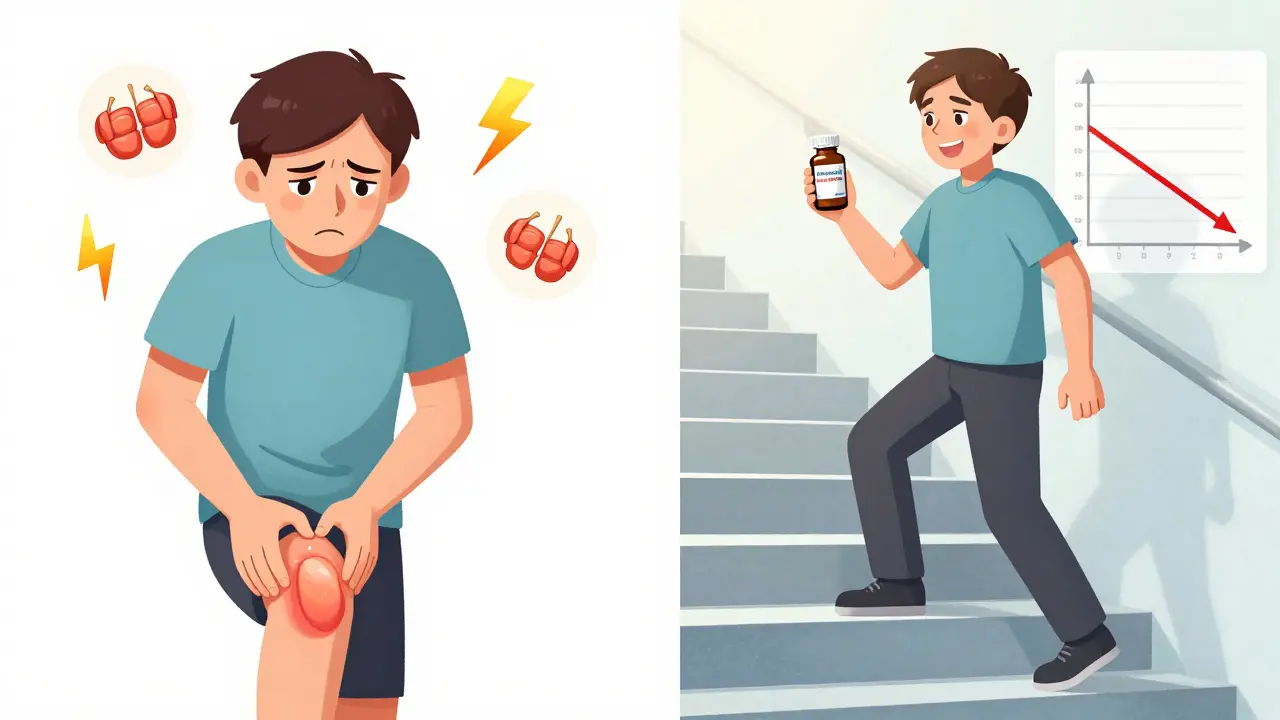
About 1 in 7 people who take statins can’t stick with them because of muscle aches, weakness, or cramps. These symptoms, known as statin-associated muscle symptoms (SAMS), aren’t always dangerous, but they’re bad enough to make people quit. And quitting statins means higher risk of heart attack or stroke - especially if you already have heart disease or high cholesterol. Doctors noticed something interesting: some statins, like atorvastatin and rosuvastatin, stick around in the body longer than others. Atorvastatin lasts 14 to 30 hours. Rosuvastatin lasts about 19 hours. That’s long enough that taking them every other day might still keep LDL levels low. So instead of forcing patients to suffer daily side effects, some clinicians started giving statins every other day - and it worked. A 2012 study by S. Pramanik tested this with 38 patients. They gave half of them 20 mg of atorvastatin daily. The other half got the same dose every other day. After 12 weeks, both groups lowered their LDL by about the same amount: 44% vs. 42%. The difference wasn’t statistically meaningful. The every-other-day group had fewer muscle problems - and saved nearly half their medication cost.Which Statins Work for Alternate-Day Dosing?
Not all statins are built the same. Short-acting ones like simvastatin or lovastatin break down too fast. Taking them every other day won’t cut it - your LDL will creep back up. The only statins with solid evidence for alternate-day use are:- Atorvastatin - the most studied. 20 mg every other day works nearly as well as 20 mg daily.
- Rosuvastatin - also strong data. Doses from 5 mg to 20 mg every other day maintain LDL control.
How Much LDL Do You Really Lose?
Let’s say your LDL is 160 mg/dL. On daily statin therapy, you might drop to 90 mg/dL - a 44% reduction. On alternate-day dosing? You’ll likely land around 100-105 mg/dL. That’s still a 35-38% drop. Not perfect, but far better than no treatment. Here’s the catch: if your goal is to get LDL below 70 mg/dL (common for people with heart disease), alternate-day dosing might not get you there alone. That’s why many doctors combine it with other meds - like ezetimibe or colesevelam. One study followed 23 patients who couldn’t tolerate daily statins. They tried ezetimibe and colesevelam on top of every-other-day statin. Result? 87% tolerated the combo. Their LDL levels matched what they’d achieved on daily statins before the side effects started. That’s huge. But if you’re on once-weekly rosuvastatin (2.5-20 mg), only 27% reached NCEP LDL goals. So frequency matters. Every other day works better than once a week.Side Effects: What’s the Real Difference?
The biggest win with alternate-day dosing isn’t cost - it’s comfort. In studies, patients switching from daily to every-other-day statins reported a 30-50% drop in muscle symptoms. One patient wrote: “I could finally walk up the stairs without my legs screaming.” Another said, “I haven’t felt this good in years.” The reason? Less drug exposure. Statins can interfere with muscle cell energy production. Less frequent dosing means your muscles get time to recover between doses. Creatine kinase (CK) levels - a marker of muscle stress - often drop back to normal when patients switch to alternate-day regimens. But here’s what most people don’t realize: this isn’t a magic fix. Some people still feel mild discomfort. And if you have very high risk - like a recent heart attack - you might need stronger LDL lowering than this method can deliver.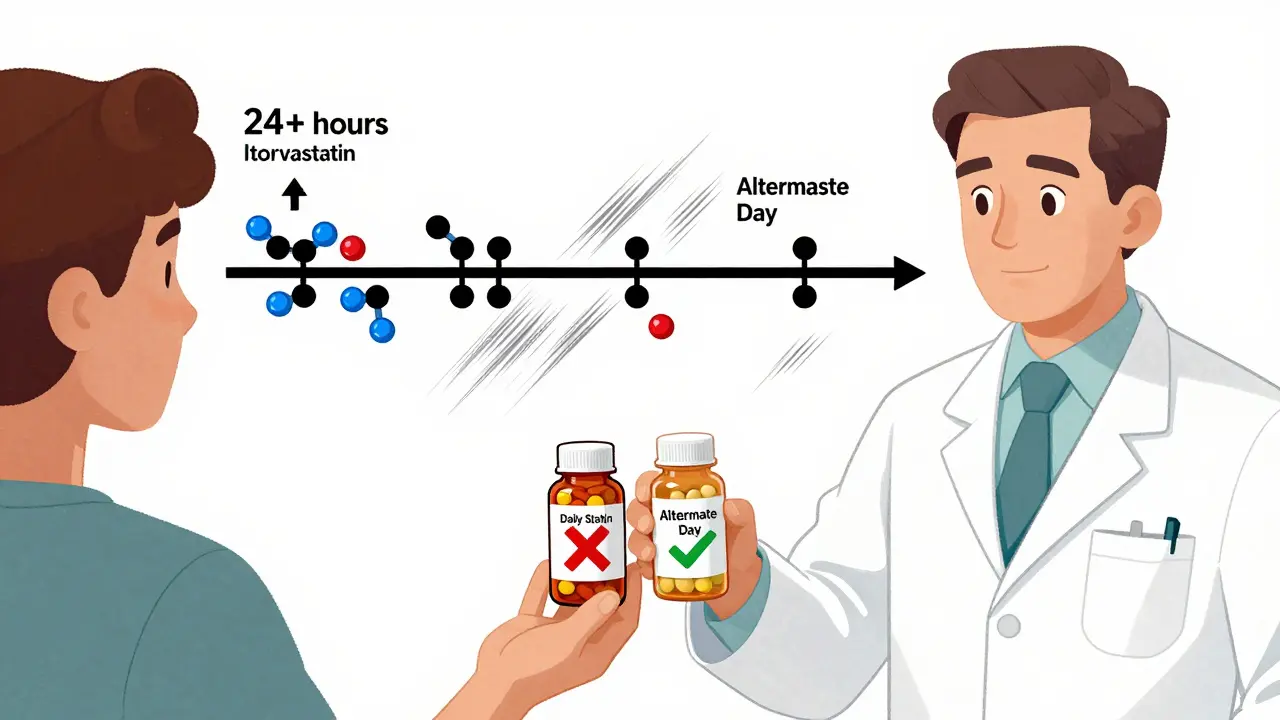
Cost Savings and Practical Benefits
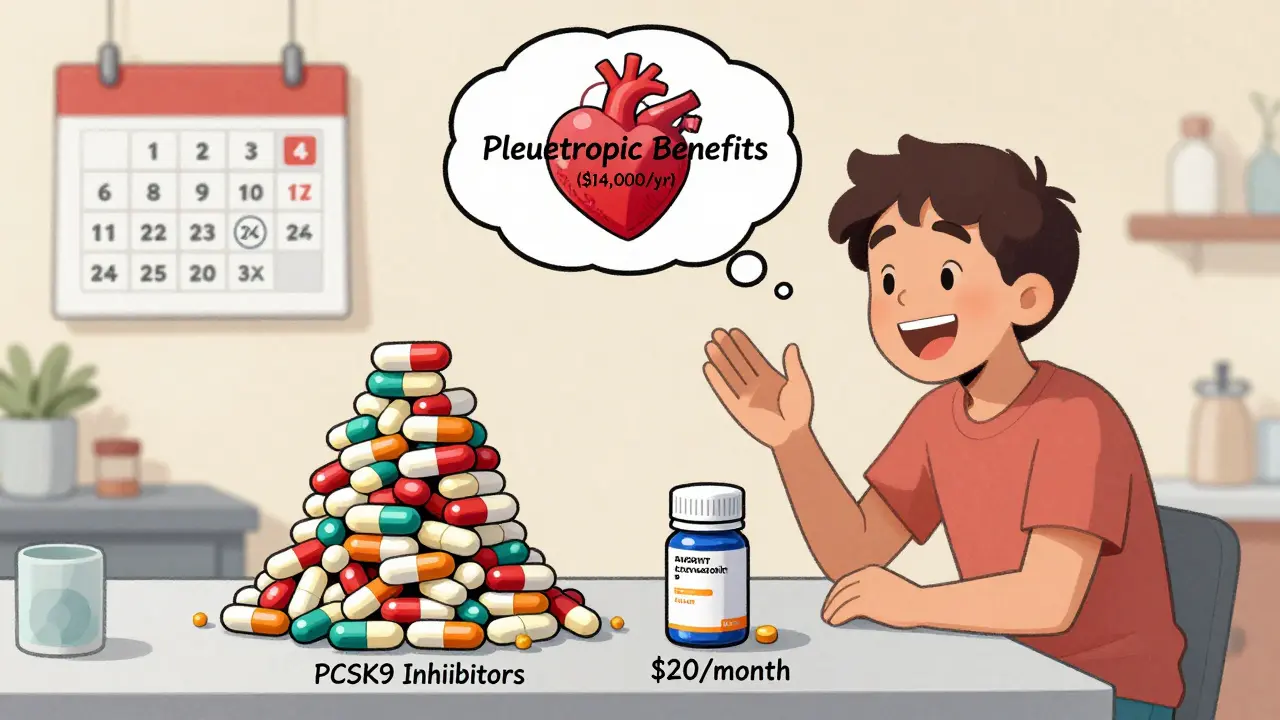
Atorvastatin generics cost as little as $0.10 per 20 mg tablet. Rosuvastatin runs $0.20-$1.00 per tablet. Daily dosing? That’s $30-$100 a month. Alternate-day? Half that - $15-$50. Compare that to other options:- Ezetimibe (Zetia): $300/month
- Bempedoic acid (Nexletol): $480/month
- PCSK9 inhibitors (Repatha, Praluent): $5,000-$14,000/year
Who Should Try This?
This isn’t for everyone. Ideal candidates:- Have documented statin intolerance (muscle pain, not liver issues or diabetes)
- Have high cardiovascular risk (history of heart attack, stroke, diabetes, or very high LDL)
- Have tried at least two daily statins and had to stop due to side effects
- Are taking atorvastatin or rosuvastatin
- People who need LDL below 70 mg/dL and can’t use combo therapy
- Those with kidney disease or liver problems - still need careful monitoring
- Anyone who forgets pills easily - every other day is harder to remember than daily
How to Start - And What to Watch For
If you and your doctor decide to try this:- Start with your current daily dose - but take it every other day. So if you take 20 mg daily, take 20 mg on Monday, skip Tuesday, take 20 mg Wednesday, and so on.
- Check your LDL in 4-6 weeks. Don’t wait longer. You need to know if it’s working.
- Track muscle symptoms using a simple scale: 0 = no pain, 10 = unbearable. Rate it weekly.
- After 3 months, if LDL is stable and symptoms are gone, you’re likely good to continue.
- If LDL is still too high, add ezetimibe (10 mg daily). It’s safe, cheap, and works well with statins.
What’s Missing? The Big Gaps
Here’s the reality: no large, long-term study has proven that alternate-day statin dosing reduces heart attacks or deaths. All the data we have shows it lowers LDL and reduces side effects. But we don’t yet know if that translates to fewer heart events. The American College of Cardiology is clear: “No clinical trial evidence exists for cardiovascular risk reduction with this approach.” That’s why it’s off-label - and why many insurers won’t cover it as a standard strategy. Also, there’s no official dosing guideline. Some doctors use every other day. Others use twice a week. Some combine it with other drugs. That inconsistency makes it harder to adopt widely.What’s Next?
Alternate-day dosing is gaining traction. A 2020 survey of 200 U.S. lipid specialists found 68% use it regularly. In academic centers, that number jumps to 82%. It’s becoming a go-to for patients who’ve run out of options. With generic statins so cheap, and PCSK9 inhibitors so expensive, this approach is becoming a smart, practical middle ground. It’s not the first-line solution - but for millions stuck between heart risk and muscle pain, it’s the only one that lets them keep living normally.Final Thought
You don’t need to take a statin every single day to protect your heart. If you’ve quit statins because of side effects, talk to your doctor about atorvastatin or rosuvastatin every other day. It’s not perfect. But for many, it’s the difference between living with pain - and living well.Can I take statins every other day instead of daily?
Yes - but only with certain statins. Atorvastatin and rosuvastatin have enough evidence to support alternate-day dosing. Other statins like simvastatin or pravastatin don’t work well this way because they leave your system too quickly. Always check with your doctor before changing your dose.
Will alternate-day statin dosing lower my LDL enough?
It typically lowers LDL by 70-80% of what daily dosing does. For example, if daily statins drop your LDL by 45%, alternate-day dosing might drop it by 30-35%. That’s often enough to reduce risk - especially if you’re not aiming for extremely low targets like under 70 mg/dL. If you need stronger lowering, your doctor may add ezetimibe.
Does alternate-day dosing reduce muscle pain?
Yes. Studies show a 30-50% reduction in muscle-related side effects compared to daily dosing. Many patients report being able to walk, climb stairs, or exercise without pain after switching. This is the main reason people choose this approach.
Is alternate-day statin dosing FDA-approved?
No. All statins are approved for daily use only. Alternate-day dosing is an off-label use - meaning it’s legal and supported by clinical evidence, but not formally approved by the FDA. Many doctors use it for statin-intolerant patients because the benefits outweigh the lack of formal approval.
How much money can I save with alternate-day dosing?
You’ll cut your statin cost by about 50%. Generic atorvastatin costs as little as $0.10 per tablet. Daily dosing (20 mg) might cost $30-$50/month. Every other day? $15-$25/month. Compared to newer drugs like PCSK9 inhibitors ($5,000-$14,000/year), this is a massive savings.
What if I forget to take my statin on the right day?
If you miss a dose, take it as soon as you remember - but don’t double up the next day. If you miss two days in a row, just resume your normal schedule. Missing one day won’t undo your progress. But if you’re inconsistent, your LDL might rise. Use a pill organizer or phone reminder to stay on track.
Can I combine alternate-day statins with other cholesterol meds?
Yes. Many patients take ezetimibe (10 mg daily) or colesevelam along with every-other-day statins. These help make up the small gap in LDL lowering. Ezetimibe is safe, inexpensive, and works well with statins. Avoid combining with other statins - that increases side effect risk.
How long does it take to see results with alternate-day dosing?
LDL levels usually stabilize within 4-6 weeks. Muscle symptoms often improve sooner - sometimes within 1-2 weeks. Your doctor will check your LDL at the 6-week mark and adjust if needed.
All Comments
Doreen Pachificus January 3, 2026
Interesting read. I’ve been on atorvastatin for years and switched to every other day last year after my muscles started screaming just walking to the mailbox. No more pain, LDL’s at 98. Doctor was skeptical but now he’s the one recommending it to others.
Justin Lowans January 5, 2026
This is precisely the kind of pragmatic, evidence-based adjustment that modern medicine needs more of. Rather than forcing patients into binary choices-take it daily or risk cardiac events-we’re finally recognizing that biology isn’t rigid. The pharmacokinetics of atorvastatin and rosuvastatin make this not just plausible, but rational. Kudos to the clinicians who’ve quietly implemented this with care.
Jason Stafford January 6, 2026
Of course this works. Big Pharma doesn’t want you to know you can cut your pills in half and save thousands. They’d rather sell you $14,000/year injections that require a nurse and a signed waiver. The FDA approves daily dosing because that’s how the patent clock ticks. This isn’t medicine-it’s a business model dressed in lab coats.
Chris Cantey January 7, 2026
I wonder if the muscle recovery isn’t just about less drug exposure, but about circadian rhythm alignment. Statins disrupt mitochondrial function-maybe taking them every other day lets the body reset its energy metabolism cycle. It’s not just dosage frequency… it’s timing. We’re treating biology like a faucet, but it’s more like a tide.
Abhishek Mondal January 8, 2026
Wait-so you’re suggesting that a 3.2 mg/dL difference in LDL reduction is ‘practically nothing’? That’s a 3.2 mg/dL difference in a metric that’s measured in single-digit increments for high-risk patients. You’re trivializing statistical significance while ignoring clinical nuance. And please, don’t call this ‘evidence-backed’-it’s anecdotal extrapolation wrapped in a meta-analysis bow.
Oluwapelumi Yakubu January 9, 2026
Man, this is the kind of thing I wish my cousin in Lagos could read. He’s got diabetes and cholesterol through the roof, but he can’t afford statins at all. If he could get atorvastatin for $15 a month instead of $50, he’d be alive today. This isn’t just science-it’s justice. Thanks for writing this like a human, not a textbook.
Terri Gladden January 10, 2026
so i tried this last year and it was like a miracle?? like i could finally lift my arms without crying?? but then i missed a dose and my legs turned to jello for a week?? idk man i think its magic or witchcraft?? also my dog started acting weird after i started taking it?? maybe the statin is talking to him??
Michael Rudge January 11, 2026
Oh, wonderful. So now we’re rewarding noncompliance with a fancy-sounding workaround? You skipped your pill, so we’ll just lower the dose? Brilliant. Next we’ll let people decide whether to take insulin every other day if their feet hurt too much. This isn’t innovation-it’s surrender dressed up like a lifestyle hack.
Cassie Tynan January 12, 2026
They say ‘the dose makes the poison’-but what if the rhythm makes the peace? Every other day isn’t about cutting corners. It’s about giving your body space to breathe. Statins are blunt instruments. Maybe we’re not supposed to use them like toothpaste-squeezing daily until the tube’s empty. Maybe we’re supposed to use them like incense: occasional, intentional, respectful.
Uzoamaka Nwankpa January 12, 2026
I’ve been taking rosuvastatin every other day for 18 months now. No muscle pain. My LDL is 102. I feel like I’ve been given my life back. But I’m scared to tell my doctor because I think he’ll say it’s ‘off-label’ and refuse to monitor me. So I just keep quiet. I don’t want to lose this.
Jennifer Glass January 14, 2026
Just wanted to say thank you for writing this so clearly. I’ve been avoiding statins for years because of the muscle pain, but I didn’t know this was even an option. My doctor never mentioned it. I’m going to bring this up next visit-no more feeling like I’m choosing between my heart and my legs.
Ethan Purser January 14, 2026
It’s funny how we’ve been conditioned to think ‘more is better’-daily pills, constant monitoring, endless prescriptions. But the body doesn’t crave abundance. It craves rhythm. Alternating doses isn’t a compromise-it’s a return to balance. We’ve forgotten that healing isn’t about force. It’s about harmony. And maybe, just maybe, the answer was never in doubling down… but in stepping back.